
Market Snapshot: Strong Gains, Late-Month Caution
Global equities performed strongly in August, with the MSCI World gaining 2.6% as healthy corporate earnings revived demand for technology shares. Emerging markets also advanced, partly benefiting from the weaker dollar. Renewed Middle East tensions and the Federal Reserve’s warnings about inflation unsettled markets later in the month, following strong gains earlier in August.
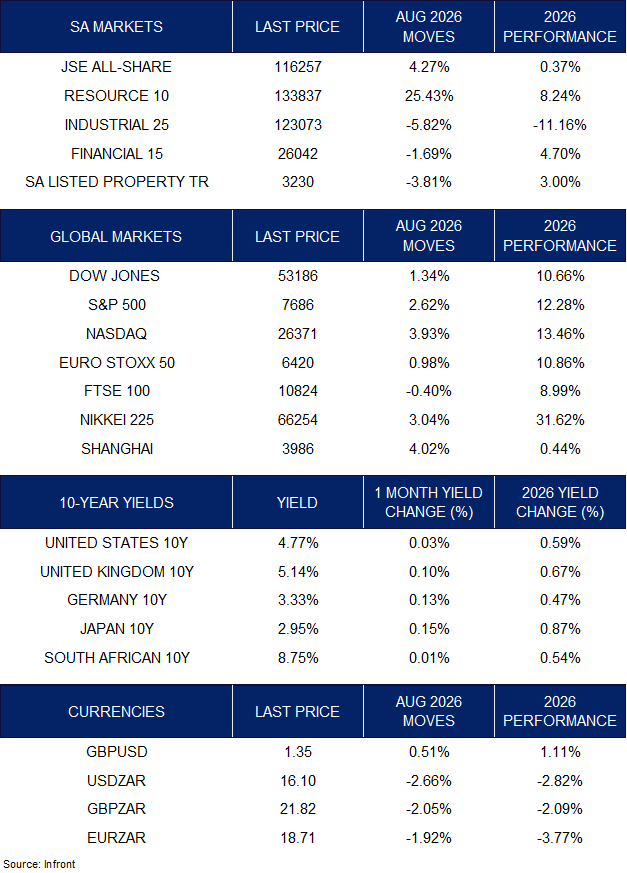
South African equities stood out, with the FTSE/JSE All-Share gaining 4.27% and returning to positive territory for the year. Higher gold and platinum prices drove strong demand for mining shares, lifting resources by 25.43%. Financials, industrials and listed property declined, leaving the JSE’s advance concentrated in the commodity sector.
Global equity markets were broadly positive, although performance varied across regions. The Nasdaq led major US indices, gaining 3.93% as technology shares recovered, while the S&P 500 and Dow Jones posted more modest gains. European markets were more subdued, with the Euro Stoxx 50 advancing 0.98% and the FTSE 100 declining 0.40%. In Asia, Japanese and mainland Chinese equities ended higher, while Hong Kong’s Hang Seng fell over the month.
10-year government-bond yields rose in the US, Europe and Japan as investors weighed inflation and government borrowing. The US yield ended August at 4.77%, while South Africa’s was broadly steady at 8.75%. The rand strengthened against the dollar, pound and euro, ending the month at R16.10 against the dollar.
Trends This Month
- Global equity leadership broadened, with emerging markets, small caps, growth and value shares advancing.
- Investors became selective within AI, as software outperformed semiconductors and attention shifted towards realised returns.
- The “debasement trade” regained momentum, with fiscal concerns and a weaker dollar supporting gold and other real assets. Corporate bonds outperformed government debt, with global high-yield credit spreads narrowing to a 12-month low.
The Cost of Capital – Government Debt and AI Borrowing Collide
Long-term borrowing costs took centre stage in August. The US 30-year Treasury yield reached its highest level since 2007 as persistent inflation, large deficits and debt above US$40 trillion unsettled investors. Planned Treasury buybacks brought temporary relief, while rising yields in Europe and Japan showed that the pressure was global.
Additionally, AI infrastructure added to demand for long-term capital. Technology companies continued to borrow to fund data centres, semiconductors and power infrastructure, competing with governments for long-term financing. As borrowing costs rose, investors became more attentive to the scale of spending and whether the growth in AI revenues can support it.
Takeaway: Strong earnings support equities, but higher borrowing costs make debt levels and the returns on new investment increasingly important.
United States – Stronger Earnings Meet Weaker Consumer Demand
Equity Performance
- Dow Jones: +1.34%
- S&P 500: +2.62%
- Nasdaq: +3.93%
The earnings improvement extended beyond the largest technology companies. By early August, Russell 2000 sales growth was running at 9%, compared with 7.5% expected before the reporting season, with contributions from energy, materials and industrial businesses. The August flash composite PMI also reached a 52-month high of 56.0, pointing to stronger business activity.
Data released during the month showed weaker hiring and consumer spending. July payrolls were initially reported to have fallen by 23,000 and retail sales declined 0.6%, while consumer confidence weakened in August. The unemployment rate fell to 4.1% alongside lower labour-force participation, so the decline did not reflect stronger hiring.
July headline CPI eased to 3.4% and core CPI to 2.5%, but PCE inflation was still 3.7% overall and 3.3% excluding food and energy. The softer jobs report reduced expectations of a September rate increase early in August, before Warsh’s Jackson Hole speech kept further tightening on the table if inflation failed to move towards target.
Outlook: September’s hiring and spending releases will help show whether strong business activity can persist as household demand weakens.
Europe – Germany Reaches a Record as France and the UK Decline
Equity Performance
- Euro Stoxx 50: +0.98%
- FTSE 100: +0.40%
European equities edged higher in August, led by Germany’s DAX, which gained 2.5% to a record high. France’s CAC 40 fell 2.1% as weaker international demand weighed on major consumer companies. German business confidence improved and eurozone economic sentiment strengthened for a fourth consecutive month, although markets continued to anticipate a September ECB rate increase.
In the UK, July inflation rose to 2.9%, while August retail surveys pointed to continued weakness in consumer demand. Payroll data also showed the number of payrolled employees falling for a sixth consecutive month, with 13,000 fewer employees in July.
Outlook: Improving eurozone sentiment is encouraging, although expectations of higher ECB rates and weak UK consumer demand remain concerns.
Japan – Equities Rebound as Rate Pressure Builds
Equity Performance
- Nikkei 225: +3.04%
Japanese equities rebounded in August, with technology earnings and semiconductor demand lifting the Nikkei. The market gave back some of those gains towards month-end as oil prices and bond yields rose.
Second-quarter GDP grew at an annualised rate of 1.1%, below the 2.0% expected, as weak consumption and investment offset resilient exports. July producer inflation stood at 7.2%, while headline and core inflation rose to 1.9% and 1.8%. Despite earlier intervention efforts, the yen weakened to around JPY159 against the dollar, adding to inflationary pressures through higher import costs. The 10-year yield climbed to a multi-decade high of 2.95%, leading markets to bring forward expectations of another BoJ rate increase to September.
Outlook: Technology demand remains encouraging, but weaker domestic growth, yen volatility and the prospect of higher interest rates could leave Japanese equities vulnerable to further volatility
China – Policy Support Lifts Shares as Consumer Spending Slows
Equity Performance
- Shanghai Composite: +4.02%
Increased fiscal spending and the PBoC’s “moderately loose” policy stance encouraged demand for mainland shares. Beijing also relaxed homebuying restrictions as support continued to target the property market. Hong Kong’s Hang Seng fell 1.2%, with property shares under pressure and Alibaba’s large equity placement adding to concerns about financing technology investment.
The economic releases explained the continued need for support. July retail sales growth slowed to 0.6% year on year from 1.0%, while industrial output growth eased to 4.5% from 5.3% despite strength in high-tech production. August’s manufacturing PMI improved to 49.8 and non-manufacturing PMI held at 49.0, both below the 50-point expansion threshold.
Outlook: Stronger retail spending and a response to property measures would provide firmer evidence that policy support is reaching the domestic economy.
South Africa – Resources Drive the JSE Higher
Equity Performance
JSE All-Share: +4.27%
Resource 10: +25.43%
Industrial 25: -5.82%
Financial 15: -1.69%
SA Listed Property: -3.81%
Higher gold and platinum group metal prices lifted mining earnings and shareholder distributions in August, driving strong gains in resource shares. Higher gold and platinum group metal prices supported mining earnings and shareholder distributions in August, driving strong gains in resource shares. Financials, industrials and listed property declined, leaving the JSE’s gains concentrated in the resource sector.
Production data released in August showed manufacturing output rising 0.9% month on month in June, while mining production increased 0.3%. Despite these monthly gains, output in both sectors remained below levels seen a year ago.
Inflation eased in July, with headline inflation falling to 4.3% on the back of lower fuel prices and slower increases in food prices. However, the labour market remained weak, with second-quarter unemployment rising to 33.6% and employment declining across seven of the ten sectors surveyed.
Outlook: Lower inflation could ease pressure on household budgets, but stronger employment and a sustained recovery in production would be needed for a broader improvement in domestic conditions.
Currencies – Rand Strengthens Against Major Currencies
Key Moves
USD/ZAR: -2.66% (16.10)
GBP/ZAR: -2.05% (21.82)
EUR/ZAR: -1.92% (18.71)
GBP/USD: +0.51% (1.35)
The rand strengthened against the dollar, pound and euro in August, making it the second-best-performing major currency after the Korean won. The move was supported by a softer US dollar, higher precious-metal prices and South Africa’s comparatively high interest rates, which continued to offer attractive relative yields for investors. Although it gave back some gains towards month-end, it ended August at R16.10 against the dollar.
Takeaway: The rand strengthened broadly over August, although it finished below its best levels of the month.
Fixed Income – Yields Rise Across Major Markets
10-Year Yields (End-August | MoM change)
United States: 4.77% | +0.03%
United Kingdom: 5.14% | +0.10%
Germany: 3.33% | +0.13%
Japan: 2.95% | +0.15%
South Africa: 8.75% | +0.01%
Government-bond yields rose across all five markets in August, weighing on bond prices. Japan and Germany recorded the largest increases as persistent inflation and expectations of further central-bank tightening pushed yields higher.
UK yields also climbed as inflation limited the Bank of England’s room to ease policy. US yields increased more modestly despite concerns about government borrowing and volatility at longer maturities. South Africa’s 10-year yield was almost unchanged against a backdrop of a stronger rand and easing inflation.
Takeaway: Global yields rose, while South Africa’s was broadly unchanged.
Final Thoughts – Strong Returns Still Require Selectivity
August was a strong month for equities, helped by healthy company earnings and renewed demand for technology shares. However, rising bond yields and persistent inflation kept interest rates in focus, particularly towards month-end. In South Africa, the All-Share rose strongly, but the gains came mainly from resources, while financials, industrials and listed property declined. The differences across sectors highlighted the importance of looking beyond headline market returns.
What this means for portfolios
- Maintain diversified exposure, as August’s gains extended across markets but returns still differed considerably by region and sector.
- Rebalance after strong gains, where resource or technology holdings have moved above their intended portfolio weights.
- Match bond duration to risk tolerance, as higher-duration bonds experience larger price movements when yields change.
- Keep decisions anchored to long-term goals, rather than allowing one strong but volatile month to determine the portfolio’s strategy.
Market Moves of The Month
Source: Infront (07 August 2026)
Chart of The Month
Source: Bloomberg (Septembert 2026)
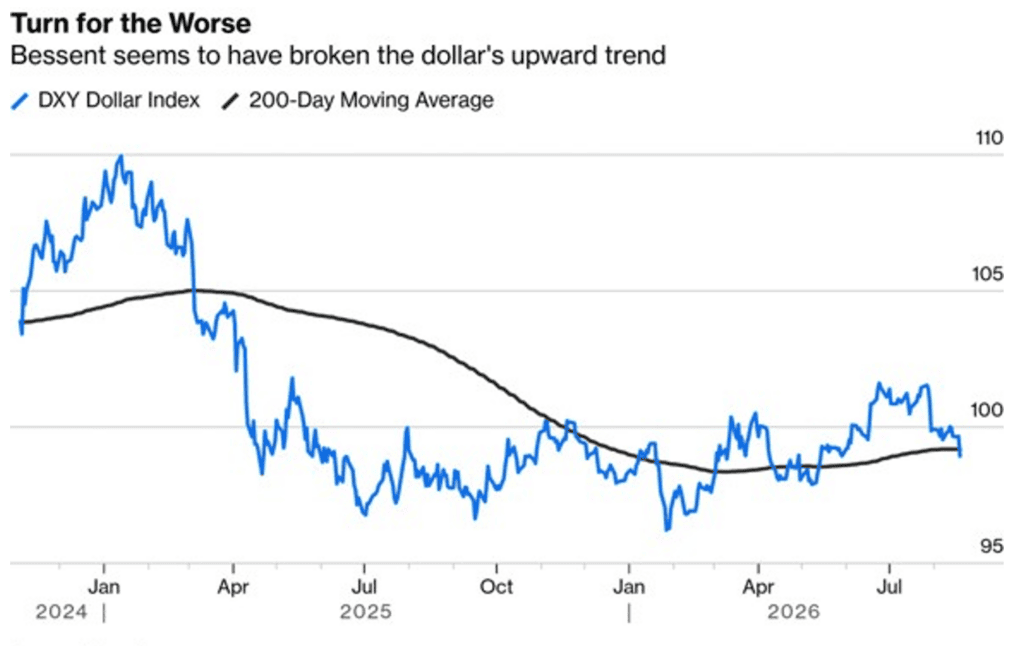
In the third week of August, the dollar fell to a three-month low after Treasury announced plans to at least double the size of longer-dated bond buyback operations from September. The announcement pushed the dollar below its 200-day moving average. Treasury prices initially rallied before giving back much of the gain, while rising gold prices reflected renewed interest in the “debasement trade”.