In This Edition:
STRONGER US PAYROLLS RESHAPE OFFSHORE RATE EXPECTATIONS
A stronger-than-expected August labour report and continued business expansion kept the US rate outlook central for globally invested South African portfolios.
OIL AND GLOBAL YIELDS RAISE THE EXTERNAL INFLATION RISK
Renewed US-Iran hostilities lifted Brent crude and sovereign yields, adding pressure to the global inflation and interest-rate backdrop.
SOFTER DEMAND ADDS TO OFFSHORE MARKET UNCERTAINTY
Weaker retail activity and energy-led producer price pressure contributed to softer European equity performance.
MIXED GROWTH SIGNALS MEET HIGHER JAPANESE YIELDS
Mixed Chinese activity and rising Japanese bond yields produced a divergent week across major Asian markets.
MANUFACTURING WEAKENS AS THE RAND FIRMS
Domestic manufacturing weakened and the JSE declined, while the rand strengthened against the US dollar.
MARKET MOVES OF THE WEEK
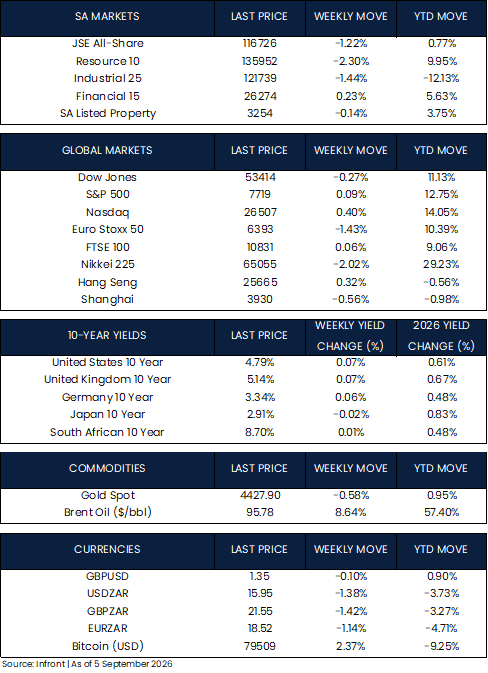
CHART OF THE WEEK
South African investors are balancing a softer domestic growth signal against a firmer rand and a more demanding global backdrop. Local manufacturing weakened further in August and the JSE declined, while stronger US employment data, rising sovereign yields and higher oil prices shifted expectations across global markets. For portfolios with offshore exposure, the interaction between global rates, currency moves and divergent equity performance remains central to how the week’s developments translate into returns.
Stronger US Payrolls Reshape Offshore Rate Expectations
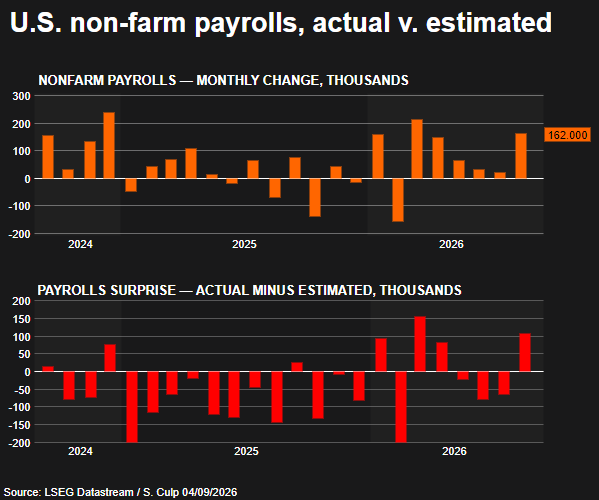
US employment data surprised to the upside in August, with nonfarm payrolls rising by 162,000, well ahead of expectations, while upward revisions to June and July added a further 55,000 jobs. The unemployment rate held steady at 4.1%, while the labour force participation rate increased to 61.6%. Other labour market indicators during the last week were somewhat mixed, with job openings edging higher to 7.27 million but falling short of expectations, while initial jobless claims were little changed. ADP data showed that private employers added just 38,000 jobs in August, the lowest monthly increase since January.
US business activity continued to point to economic expansion in August. Despite easing from 55.6 in July to 54.6, the ISM manufacturing PMI remained in expansion territory for an eighth consecutive month, with new orders, production and employment all continuing to expand. Meanwhile, services activity strengthened, with the ISM services PMI rising 1.3 percentage points to 55.4 as new orders and backlogs improved, although the prices paid component climbed to its highest level in four years.
Oil and Global Yields Raise the External Inflation Risk
The conflict between Washington and Tehran escalated sharply last week, with the US launching a pre-emptive strike against an Iranian island in the Strait of Hormuz to prevent Iran from laying new sea mines. Brent crude rose 8.64% over the last week to $95.78/bbl as concerns over potential supply disruptions resurfaced, adding to inflation concerns.
Global government bond yields also rose sharply, reaching levels not seen in years. The US 10-year Treasury yield reached an intraday high of 4.85%, its highest since January 2025, while yields in the UK and Japan also rose to multi-year highs. A Bloomberg gauge of global sovereign bonds climbed to 3.78%, its highest level since mid-2008. Yields subsequently retraced from their intraday highs, with the US 10-year Treasury closing the week at 4.79%, up 7 bps.
Major US equity indices finished the last week narrowly mixed as investors weighed renewed US-Iran hostilities, higher oil prices, stronger employment data and shifting expectations for Federal Reserve policy. The Dow Jones Industrial Average fell 0.27%, while the S&P 500 gained 0.09% and the Nasdaq Composite rose 0.40%.
Softer Demand Adds to Offshore Market Uncertainty
Eurozone retail sales fell 0.6% month on month in July, the sharpest decline since May 2025, with Germany, Spain and Italy all recording lower sales volumes, while France and the Netherlands saw growth. Producer price inflation, however, surprised to the upside, with prices rising 1.6% from June, driven by a sharp increase in energy-related costs. Capital goods prices rose by just 0.3%, while prices for nondurable consumer goods declined.
European equities came under pressure early over the last week as renewed US-Iran hostilities pushed energy prices and government bond yields higher. Sentiment later stabilised as energy prices eased from their highs and rate concerns moderated. The STOXX Europe 50 fell 1.43% for the week, while the FTSE 100 was broadly flat.
Mixed Growth Signals Meet Higher Japanese Yields
China’s economic data remained mixed in August, with the official manufacturing PMI improving to 49.8 from 49.2, although it stayed below the 50 threshold for a second consecutive month. Production, new orders and export orders improved, but the official non-manufacturing PMI remained at 49.0, its lowest level since December 2022. The private sector painted a more positive picture, with the RatingDog manufacturing PMI rising to 51.5 from 50.9, supported by stronger output and new orders, while the services PMI increased to 51.4 on stronger domestic demand.
Asian markets were mixed over the last week. Japan’s Nikkei 225 fell 2.02%, pressured by rising JGB yields and growing expectations of near-term BoJ tightening, while a stronger yen later in the week added further pressure on exporters.
Mainland Chinese equities diverged from Hong Kong, with fading momentum in AI-related shares weighing on the Shanghai Composite, which fell 0.56%, while the Hang Seng rose 0.32% in local currency terms as it recovered towards the end of the last week.
Manufacturing Weakens as the Rand Firms
South Africa’s manufacturing sector weakened further in August, with the Absa Manufacturing PMI falling to 45.8 from 46.8, marking its fourth consecutive monthly decline and its lowest reading of 2026. The deterioration was driven by a sharp drop in business activity and new orders, with Absa pointing to subdued domestic demand, weak consumer confidence and softer spending on non-essential goods. Export sales, however, showed some improvement.
The broader private sector offered a slightly more positive signal, with the S&P Global PMI edging up to 50.5 from 50.3, supported by a modest increase in new orders and a second consecutive month of output growth. Purchasing activity also strengthened, although export sales remained only marginally positive, suggesting that the path to a stronger recovery remains uncertain.
South African equities came under pressure last week, with the JSE All Share falling 1.22%, led by a 2.30% decline in the Resources 10 and a 1.44% fall in the Industrial 25. Listed property and Financials were relatively resilient, slipping 0.14% and gaining 0.23%, respectively. The rand, however, strengthened against the US dollar, closing Friday at R15.95/$.
The information contained in this recording/presentation is for general information purposes only and should not be construed as, nor does it constitute, financial, tax, legal, investment or any other advice. Carrick does not guarantee the suitability or potential value of any products or investments discussed herein. We make no representations or warranties of any kind, express or implied, about the completeness, accuracy, reliability, suitability or availability with respect to the information, products, services, or any other content contained in this recording for any purpose. Carrick accepts no responsibility for the suitability or accuracy of the information or for any errors or omissions that may occur. Therefore, any reliance you place on such information is strictly at your own risk. This material is provided for general information purposes only and is not personal advice to anyone to invest in any fund or product. Information taken from trade and other sources is believed to be reliable, although Carrick does not represent this as accurate or complete and it shouldn’t be relied upon as such. All material, content, and information provided by Carrick is the intellectual property of Carrick Group and its affiliates, unless otherwise stated. No part of this material may be copied, reproduced, distributed, published, or used for any commercial purpose without Carrick’s prior written consent, and is provided solely for non-commercial use. Capital is at risk. The value and income from investments can go down as well as up and are not guaranteed. An investor may get back significantly less than they invest. Past performance is not a reliable indicator of current or future performance and should not be the sole factor considered when selecting an investment.