
In This Edition:
GLOBAL ENERGY AND BOND REPRICING RESHAPE THE BACKDROP
Brent crude rose to $104.35 as government yields reached fresh 2026 highs, increasing pressure on global equities and rate expectations.
US INFLATION KEEPS TREASURY YIELDS ELEVATED
August consumer and producer prices rose while the 10-year Treasury yield climbed to 4.97%, keeping US rate expectations in focus.
EUROPE TIGHTENS AS GROWTH SIGNALS DIVERGE
The ECB raised its deposit rate, European equities fell, and UK growth surprised positively as bond yields continued higher.
JAPAN AND CHINA SEND MIXED ASIAN SIGNALS
Japan saw softer producer prices but firm manufacturing confidence, while Chinese trade growth remained strong and equities weakened.
SOUTH AFRICAN GROWTH AND THE RAND COME UNDER PRESSURE
GDP contracted, the current account moved into deficit, and the rand and local assets weakened, reinforcing the domestic impact of global energy and rate pressures.
MARKET MOVES OF THE WEEK
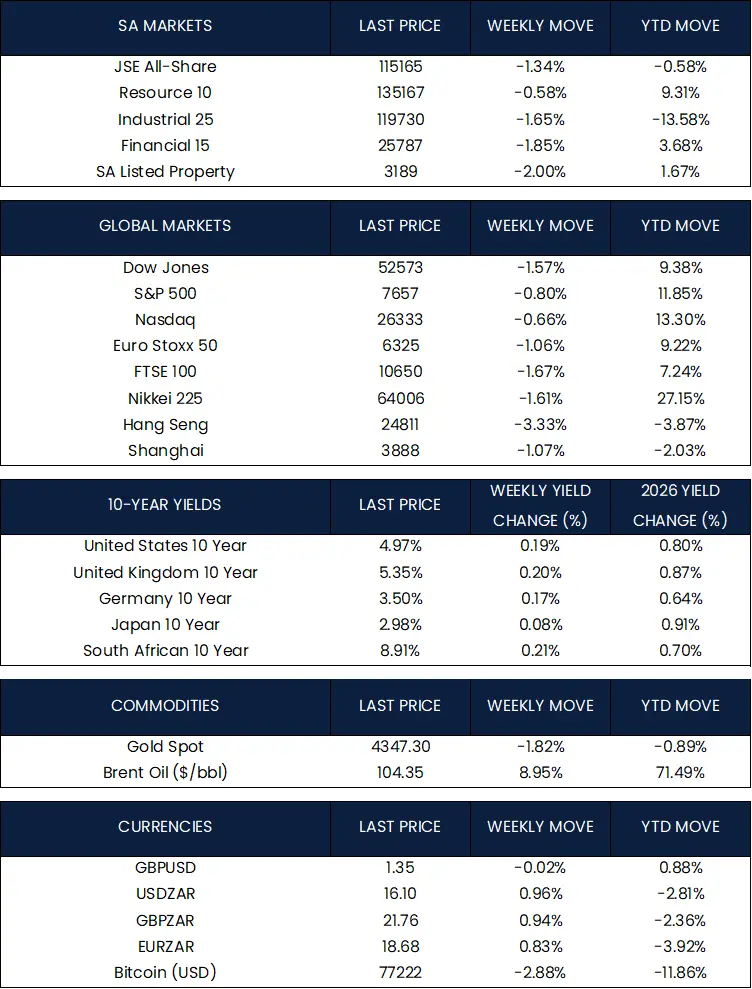
CHART OF THE WEEK
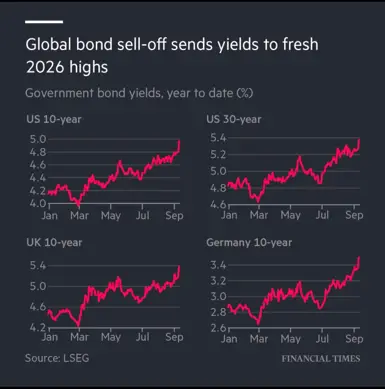
For South African investors, last week’s rise in global oil prices and bond yields comes alongside softer domestic growth and renewed pressure on local assets. GDP contracted 0.2% quarter-on-quarter in the second quarter, while the current account moved to a deficit of 2.6% of GDP as higher crude-oil import costs weighed on the trade balance. The rand weakened to R16.10 against the US dollar over the week, and the 10-year government bond yield rose to 8.91%. With Brent crude above $100 per barrel and major central banks still focused on inflation, global rates, energy prices and currency movements remain important drivers of both domestic conditions and offshore portfolio returns.
Global Energy and Bond Repricing Reshape the Backdrop
Global equities ended the last week lower amid renewed US-Iran conflict, with Brent crude climbing to $104.35 per barrel. The International Energy Agency pushed back its forecast for a full recovery in Middle Eastern oil supplies to 2027, while projecting global oil demand to decline by 2.5 million barrels per day in 2026.
Government bonds came under pressure across global markets, with yields reaching fresh 2026 highs in the US, UK and Germany. Higher energy prices reinforced expectations of further interest rate increases, while concerns over fiscal deficits and heavy debt issuance added to the selling pressure. Corporate borrowing also contributed to debt supply, with large US cloud providers raising around USD 220 billion over the past year to fund cloud and data centre expansion.
US Inflation Keeps Treasury Yields Elevated
In the US, the 10-year Treasury yield increased 19 basis points over the last week to 4.97%. The Treasury also announced plans to improve liquidity in longer-dated bonds through a buyback of up to USD 6 billion in debt maturing in 10 to 20 years, triple the size of its previous long-dated operation.
US inflation data released last week showed consumer prices increasing 0.4% in August, up from 0.1% in July. Annual headline inflation remained at 3.4%, while core inflation eased to 2.4% from 2.5%. Producer prices also increased 0.4% over the month, taking annual producer inflation to 5.4%.
Other data released during the last week showed new applications for unemployment benefits falling by 1,000 to 206,000 in the week ended 5 September. Housing activity was softer, with existing home sales declining 2.0% in August to an annualised rate of 3.98 million, their slowest pace in more than a year.
Against this backdrop, US equities closed the last week lower, with the Dow declining 1.57%, the S&P 500 falling 0.80% and the Nasdaq losing 0.66%.
Europe Tightens as Growth Signals Diverge
European equities also declined, with the Euro Stoxx 50 down 1.06% and the FTSE 100 losing 1.67%. The ECB announced a 25 basis point increase in its deposit rate to 2.50%, effective 16 September, as higher energy costs fuelled inflation. In France, the government lowered its 2026 growth forecast to 0.5% from 0.7%, while also confirming it would miss its budget deficit target.
UK growth data released during the last week showed the economy expanding 0.4% in July, ahead of expectations of no growth. Services provided the largest contribution, with production and construction also increasing.
Government bond yields continued rising across the region, with Germany’s 10-year yield increasing 17 basis points to 3.50% and the UK equivalent climbing 20 basis points to 5.35%.
Japan and China Send Mixed Asian Signals
In Japan, producer prices fell 0.2%, marking their first monthly decline in a year as energy and agricultural prices eased. Annual producer inflation also eased to 7.6% from 7.7%, while import prices fell 3.0% over the month, partly reflecting a stronger yen and lower petroleum and gas prices during August.
Manufacturing confidence reached its highest level since December 2021, supported by strong semiconductor and data centre demand, with transport companies also benefiting from this activity.
Japanese equities ended the week lower, with the Nikkei 225 down 1.61%, while the 10-year government bond yield rose 8 basis points to 2.98%.
Chinese trade data released last week showed exports increasing 25% year-on-year in August, up from 23.9% in July, while imports grew 28.2%. The trade surplus reached USD 119.1 billion, with technology-related exports continuing to expand.
On inflation, data showed annual producer price growth accelerating to 3.8% from 3.5%, above expectations of 3.6%, while consumer prices increased 0.8% year-on-year.
Chinese equities ended last week lower, with the Shanghai Composite declining 1.07% and Hong Kong’s Hang Seng losing 3.33%.
Week Ahead: Major Central Banks Take Centre Stage
In the week ahead, interest rates will remain in focus as the Federal Reserve, Bank of England and Bank of Japan announce their monetary policy decisions against a backdrop of elevated energy prices. The Bank of England will also decide how much further to reduce its bond holdings over the coming year.
South African Growth and the Rand Come Under Pressure
Turning to South Africa, equities ended last week lower, with the JSE All-Share Index declining 1.34%. Listed property led the losses with a 2.00% decline, followed by financials and industrials, down 1.85% and 1.65% respectively, while resources recorded a smaller decline of 0.58%. Local government bonds also came under pressure, with the 10-year yield increasing 21 basis points over the week to 8.91%.
On the economy, data released last week showed GDP contracting 0.2% quarter-on-quarter in the second quarter after six consecutive quarters of growth, with mining, manufacturing and trade declining. Household consumption increased 0.4%, while fixed investment fell for a second consecutive quarter, and higher imports also reduced growth.
Higher import spending also contributed to the current account shifting from a surplus of 2.3% of GDP in the first quarter to a deficit of 2.6% in the second. Oil costs were a major contributor, with the value of crude-oil imports increasing 82% while volumes rose just 1.8%.
In the currency markets, the rand weakened against the major currencies, with the US dollar gaining 0.96% to R16.10, sterling rising 0.94% to R21.76 and the euro advancing 0.83% to R18.68 over the last week.
The information contained in this recording/presentation is for general information purposes only and should not be construed as, nor does it constitute, financial, tax, legal, investment or any other advice. Carrick does not guarantee the suitability or potential value of any products or investments discussed herein. We make no representations or warranties of any kind, express or implied, about the completeness, accuracy, reliability, suitability or availability with respect to the information, products, services, or any other content contained in this recording for any purpose. Carrick accepts no responsibility for the suitability or accuracy of the information or for any errors or omissions that may occur. Therefore, any reliance you place on such information is strictly at your own risk. This material is provided for general information purposes only and is not personal advice to anyone to invest in any fund or product. Information taken from trade and other sources is believed to be reliable, although Carrick does not represent this as accurate or complete and it shouldn’t be relied upon as such. All material, content, and information provided by Carrick is the intellectual property of Carrick Group and its affiliates, unless otherwise stated. No part of this material may be copied, reproduced, distributed, published, or used for any commercial purpose without Carrick’s prior written consent, and is provided solely for non-commercial use. Capital is at risk. The value and income from investments can go down as well as up and are not guaranteed. An investor may get back significantly less than they invest. Past performance is not a reliable indicator of current or future performance and should not be the sole factor considered when selecting an investment.