
Market Snapshot: Rate Hikes and a Bond Sell-Off Shape September
Global equities were mostly weaker in September as rising bond yields and renewed Middle East tensions weighed on sentiment. Higher oil prices added to inflation concerns as several major central banks raised interest rates. Strong demand for AI-related shares provided some support, although gains remained concentrated in a small group of companies.
South African equities had a weaker month, with the FTSE/JSE All-Share declining 6.67% as lower gold and platinum prices weighed on mining shares, leaving resources down 10.95%. Financials and industrials also declined, while selected retailers and energy companies were more resilient.
The Nasdaq was among the stronger markets, gaining 1.86% while the S&P 500 and Dow Jones declined, and Japan’s Nikkei edged 0.75% higher as semiconductor shares recovered. European markets were weaker, with the Euro Stoxx 50 falling 2.35% and the FTSE 100 losing 2.02%, while mainland Chinese and Hong Kong equities also declined.
September saw government bonds come under pressure from higher energy costs and heavy debt issuance, with 10-year government-bond yields rising in the US, UK, Germany, Japan and South Africa. The US yield ended at 5.29% and South Africa’s at 8.96%. The rand weakened against the dollar, closing at R16.42, but strengthened against the pound and euro.
Trends This Month
- US Treasury yields returned to pre-financial-crisis levels as inflation concerns and heavy government borrowing intensified the bond sell-off.
- Equity returns became more concentrated, with AI beneficiaries supporting headline US indices while financials, utilities and real estate declined.
- September saw interest-rate hikes across several major economies, including the US, eurozone, Japan and South Africa.
The Price of Inflation – Rate Hikes and the Bond Sell-Off
September’s rate increases reflected concern that sustained increases in energy costs could feed into broader inflation. The Fed, ECB, BoJ and SARB tightened policy during the month, while bond investors also faced heavy government issuance. Alongside inflation, the scale of US government debt, at around US$40 trillion, remained a concern for investors lending over longer periods.
Corporate borrowing added to the demand for funding. Large US cloud providers raised around US$220 billion over the preceding year to finance cloud and data-centre expansion, bringing substantial private-sector borrowing alongside government financing needs.
Takeaway: The pressure on borrowing costs extended beyond central-bank decisions, with governments and companies seeking substantial funding.
United States – Technology Shares Hold Up as Rates Rise
Equity Performance:
Dow Jones: -4.29%
S&P 500: -0.45%
Nasdaq: +1.86%
Strong demand for semiconductors and the adoption of new AI products supported technology shares, with the Nasdaq gaining 1.86% while the S&P 500 and Dow Jones declined. The equal-weighted S&P 500 fell considerably more than the headline index, suggesting that this support was concentrated in a small group of large companies. Higher bond yields also put pressure on dividend-paying sectors, including utilities and real estate.
Economic activity remained resilient. August payrolls rose by 162,000, well ahead of expectations, while retail sales also increased strongly that month. September’s flash composite PMI reached 58.4, its highest level in more than five years, with both manufacturing and services activity strengthening.
The Fed raised its target range by 25 basis points to 3.75%-4.00%, its first increase in three years. August headline inflation held at 3.4% and core inflation eased to 2.4%, although elevated energy prices kept further tightening under consideration. The Fed’s updated projections suggested another increase remained possible before year-end.
Outlook: Strong business activity provides some support for earnings, although higher borrowing costs could weigh on demand.
Europe – Business Activity Improves as Inflation Rises
Equity Performance:
Euro Stoxx 50: -2.35%
FTSE 100: -2.02%
European equities declined as higher borrowing costs and energy prices weighed on sentiment. The ECB raised its deposit rate by 25 basis points to 2.50%, with August eurozone inflation accelerating to 3.2%. September’s flash composite PMI rose to 53.1, with French business activity returning to expansion. Earlier in the month, the French government lowered its annual growth forecast and confirmed it would miss its deficit target.
In the UK, August inflation rose to 3.1%, while the Bank of England held rates at 3.75% in a split vote. July GDP growth was stronger than expected, but September surveys showed retail sales weakening and services activity losing momentum. The data left policymakers weighing persistent price pressure against subdued demand.
Outlook: Improving eurozone business activity is encouraging, although high energy costs and weak UK spending continue to limit the recovery.
Japan – Technology Shares Advance as the BoJ Tightens
Equity Performance:
Euro Stoxx 50: -2.35%
FTSE 100: -2.02%
European equities declined as higher borrowing costs and energy prices weighed on sentiment. The ECB raised its deposit rate by 25 basis points to 2.50%, with August eurozone inflation accelerating to 3.2%. September’s flash composite PMI rose to 53.1, with French business activity returning to expansion. Earlier in the month, the French government lowered its annual growth forecast and confirmed it would miss its deficit target.
In the UK, August inflation rose to 3.1%, while the Bank of England held rates at 3.75% in a split vote. July GDP growth was stronger than expected, but September surveys showed retail sales weakening and services activity losing momentum. The data left policymakers weighing persistent price pressure against subdued demand.
Outlook: Improving eurozone business activity is encouraging, although high energy costs and weak UK spending continue to limit the recovery.
China – Exports Strengthen as Household Demand Remains Weak
Equity Performance:
- Shanghai Composite: -3.62%
Mainland Chinese and Hong Kong equities declined in September as domestic demand remained subdued and the property sector continued to struggle, with technology shares among the weaker performers in Hong Kong. The US and China extended their trade truce until 10 January 2027, easing near-term trade uncertainty.
Economic data showed stronger exports and production alongside weak household spending. In August, exports grew 25% in US dollar terms, industrial output increased 5.2% and retail sales rose just 0.4%, all compared with a year earlier. September’s official manufacturing and non-manufacturing PMIs returned to expansion at 50.1 and 50.2, although weak investment and slower credit growth suggested the recovery remained uneven.
Outlook: Strong exports and improving business surveys are encouraging, but weak household spending and property-sector pressure continue to constrain domestic growth.
South Africa – Mining Shares Retreat as the SARB Raises Rates
Equity Performance:
Shanghai Composite: -3.62%
Mainland Chinese and Hong Kong equities declined in September as domestic demand remained subdued and the property sector continued to struggle, with technology shares among the weaker performers in Hong Kong. The US and China extended their trade truce until 10 January 2027, easing near-term trade uncertainty.
Economic data showed stronger exports and production alongside weak household spending. In August, exports grew 25% in US dollar terms, industrial output increased 5.2% and retail sales rose just 0.4%, all compared with a year earlier. September’s official manufacturing and non-manufacturing PMIs returned to expansion at 50.1 and 50.2, although weak investment and slower credit growth suggested the recovery remained uneven.
Outlook: Strong exports and improving business surveys are encouraging, but weak household spending and property-sector pressure continue to constrain domestic growth.
Currencies – Dollar Strengthen as Rand Performance Varies
Equity Performance:
Shanghai Composite: -3.62%
Mainland Chinese and Hong Kong equities declined in September as domestic demand remained subdued and the property sector continued to struggle, with technology shares among the weaker performers in Hong Kong. The US and China extended their trade truce until 10 January 2027, easing near-term trade uncertainty.
Economic data showed stronger exports and production alongside weak household spending. In August, exports grew 25% in US dollar terms, industrial output increased 5.2% and retail sales rose just 0.4%, all compared with a year earlier. September’s official manufacturing and non-manufacturing PMIs returned to expansion at 50.1 and 50.2, although weak investment and slower credit growth suggested the recovery remained uneven.
Outlook: Strong exports and improving business surveys are encouraging, but weak household spending and property-sector pressure continue to constrain domestic growth.
Fixed Income – Bond Yields Rise Across Major Markets
10-Year Yields (End-September | MoM change):
United States: 5.29% | +0.52%
United Kingdom: 5.42% | +0.28%
Germany: 3.58% | +0.25%
Japan: 3.07% | +0.12%
South Africa: 8.96% | +0.21%
The US led September’s rise in government-bond yields, with its 10-year yield increasing by 0.52 percentage points to 5.29%. Yields also rose in the UK, Germany, Japan and South Africa, extending the pressure on bond prices across major markets.
In the US, the Treasury also announced a buyback of up to US$6 billion in bonds maturing in 10 to 20 years, three times the size of its previous longer-dated operation, aimed at improving liquidity in that part of the market.
Takeaway: Longer-dated bonds remained particularly sensitive to the rise in yields.
Final Thoughts – Stronger Activity, Weaker Confidence
Higher bond yields have increased the income available to investors, giving equities more competition for capital. US business activity strengthened, but consumer confidence weakened as households became more concerned about prices. This contrast suggests that resilient headline activity has not removed the pressure felt by consumers, leaving confidence and spending important indicators to watch.
What this means for portfolios:
- Keep exposure spread across markets and sectors, as gains in selected AI shares offered limited support to the broader equity market.
- Review bond holdings as yields rise. Higher yields offer more income on new investments, but longer-dated bonds remain vulnerable to further rises in yields.
- Review exposure to companies with high debt levels, as higher interest rates can make refinancing more expensive.
- Keep portfolio changes aligned with long-term goals. The pullback in mining shares after August’s gains is a reminder of how quickly performance can change.
Market Moves of The Month
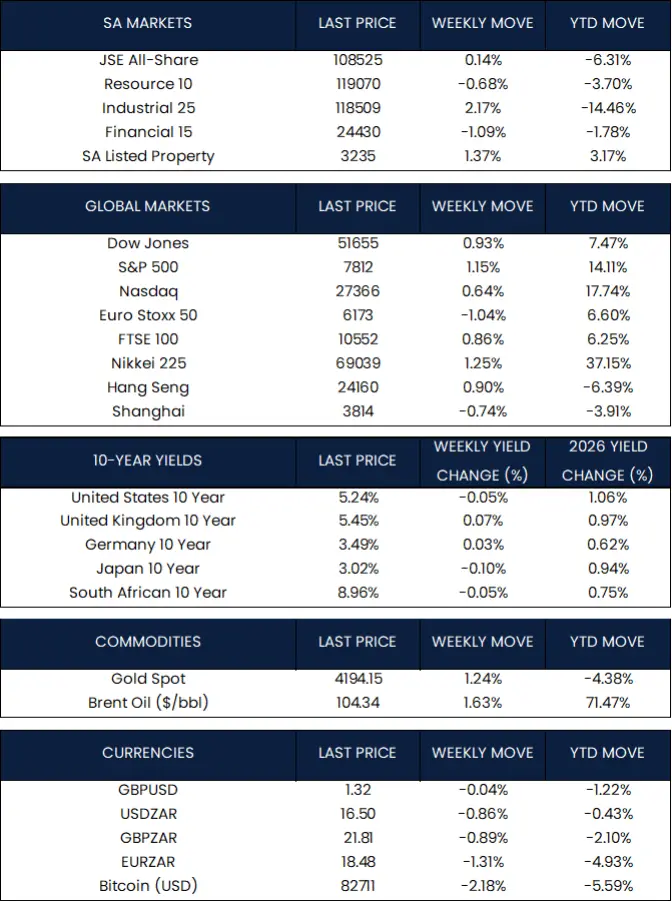
Source: Infront (07 August 2026)
Chart of The Month
Source: Bloomberg (Septembert 2026)
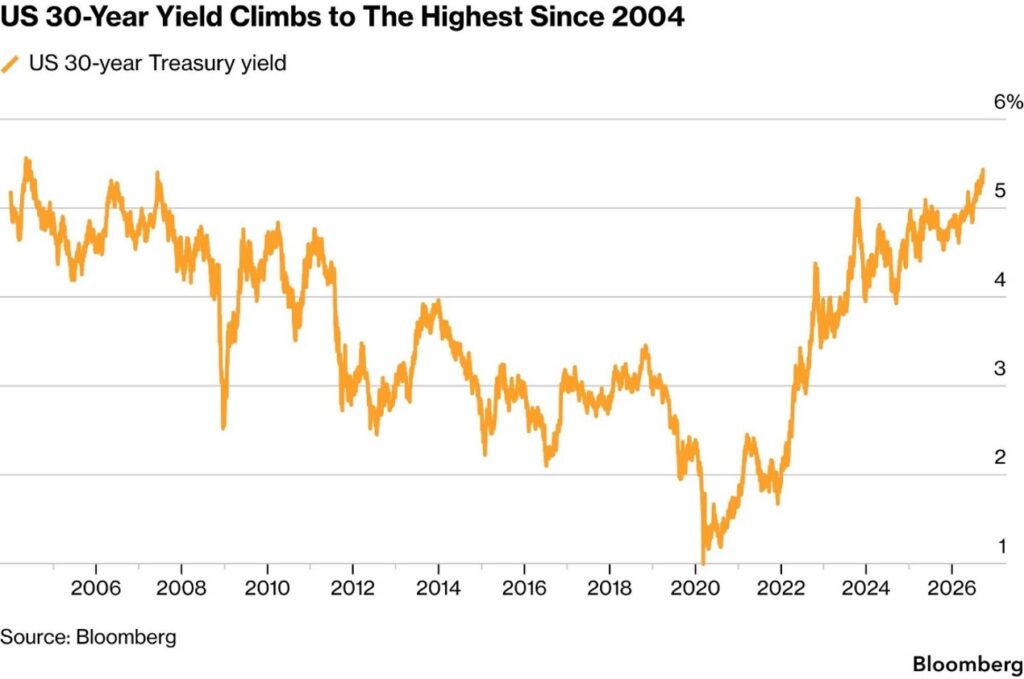
The US 30-year Treasury yield reached 5.47% in late September, its highest level since 2004 at that point. The chart shows how far long-term yields have risen from their 2020 lows, with much of the increase occurring from 2022 onwards. September’s rise extended that longer-term adjustment in borrowing costs.