
June was an uneven month for markets. Lower oil prices helped improve sentiment as easing tensions between the United States and Iran reduced fears of a prolonged energy shock, but inflation and interest-rate concerns remained important. At the same time, investors became more cautious toward AI-linked technology shares after a strong earlier rally.
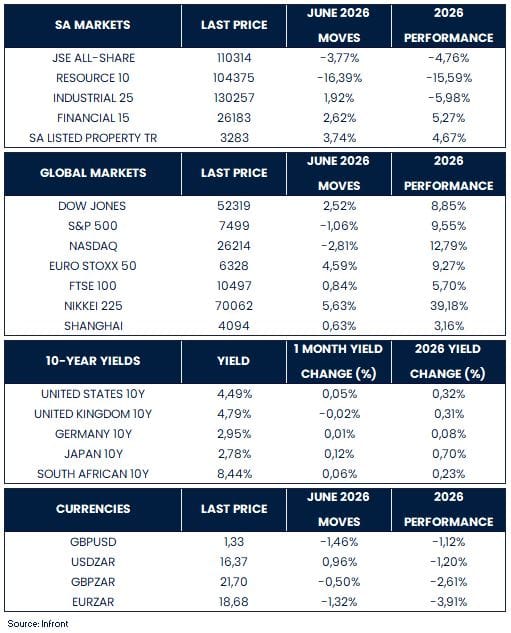
South African equities weakened further, leaving the FTSE/JSE All-Share down 3.77% for the month and 4.76% year-to-date. Resources were the main drag, falling 16.39%, while Industrials rose 1.92%, Financials gained 2.62% and listed property rose 3.74%. Sentiment was also supported by South Africa's improved credit profile following Fitch's upgrade to BB.
Global equities were mixed. The Dow Jones gained 2.52% and the S&P 500 fell 1.06%, while the Nasdaq fell 2.81% as investors became more cautious on AI-linked and semiconductor shares. Japan was the standout performer, with the Nikkei 225 up 5.63%, while Europe advanced strongly, with the Euro Stoxx 50 gaining 4.59%. China was only up slightly, with the Shanghai Composite up 0.63%.
Bond markets lacked a clear direction, with the US 10-year yield rising to 4.49%, showing that inflation concerns had not fully faded. South Africa's 10-year yield also moved higher. The rand was slightly weaker against the dollar, with USD/ZAR ending at R16.37, although it remained stronger year-to-date.
Trends This Month:
- South Africa's fiscal credibility improved, with Fitch upgrading the country to BB and Q1 GDP coming in ahead of expectations.
- US-Iran de-escalation helped lower oil prices, easing some of the inflation pressure that had weighed on markets earlier in the quarter.
- SpaceX's record IPO drew strong market attention.
- Emerging markets benefited from the Q2 AI supply-chain rally, although AI shares weakened into month-end.
Middle East Conflict - De-Escalation Eases Oil Pressure
The Middle East conflict remained a major macro driver in June, but the tone improved as the war moved toward de-escalation. Oil prices fell sharply after earlier spikes, as markets expected improved energy flows through the Strait of Hormuz following progress between the United States and Iran.
The key market impact was through inflation and interest-rate expectations. Lower oil prices reduced some pressure on fuel costs and gave investors more confidence, but central banks remained cautious because the earlier energy shock could still appear in inflation data over the coming months.
Takeaway:
Lower oil prices are supportive for markets, but the conflict remains an important risk until energy flows and inflation pressures normalise.
United States - Resilient Economy, Uneven Markets
Equity Performance:
Dow Jones: +2.52%
S&P 500: -1.06%
Nasdaq: -2.81%
The U.S. economy remained resilient, although jobs growth was revised lower, with May payrolls cut to 129,000 and unemployment steady at 4.3%. Corporate earnings were stronger, with 85% of S&P 500 companies beating expectations.
Markets became more selective into month-end. Micron's strong earnings briefly supported AI and semiconductor shares, but the rebound faded as investors questioned whether the AI trade had moved too far. This weighed on the Nasdaq and S&P 500, while the Dow ended higher.
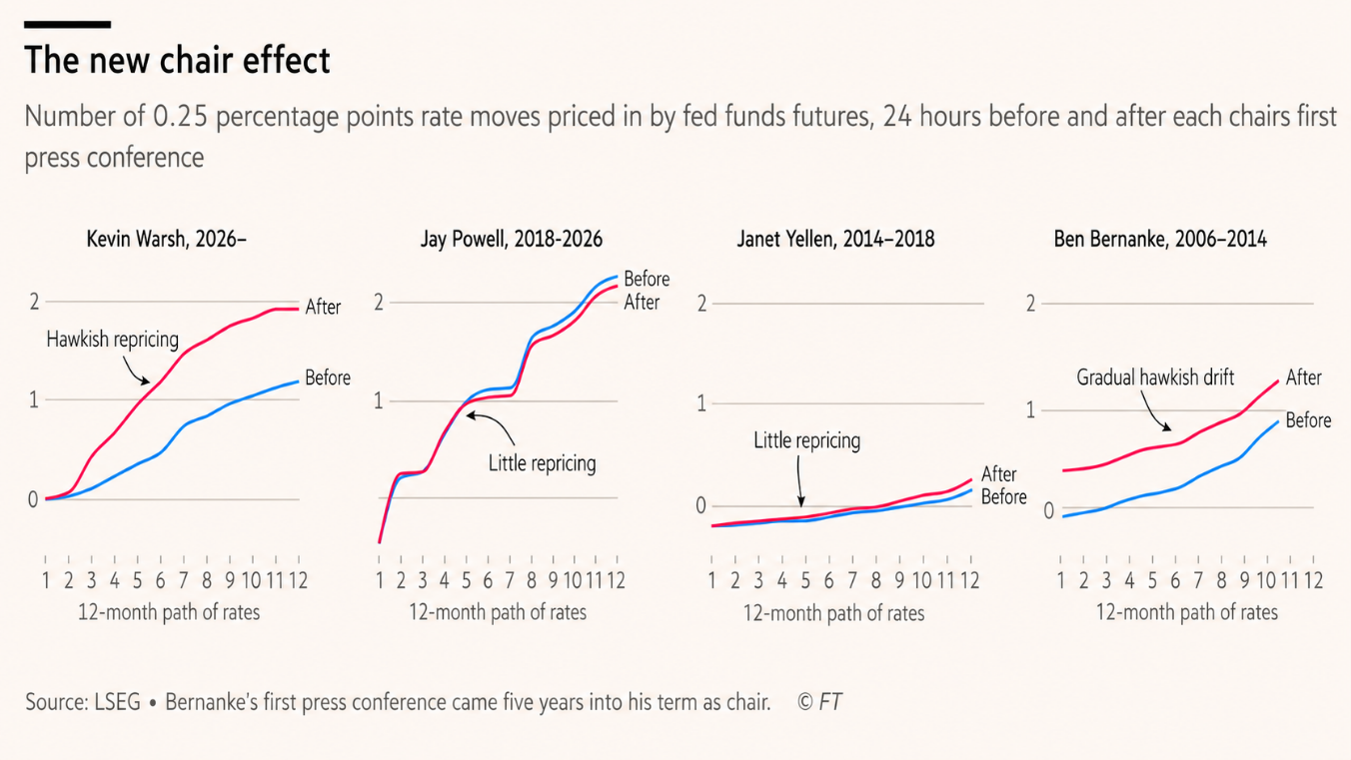
Monetary policy remained a key risk. Kevin Warsh's first Fed press conference triggered a more hawkish repricing, with markets moving closer to pricing the possibility of another Fed hike by year-end.
Outlook:
The U.S. backdrop remains supported by earnings and economic resilience, but markets are more sensitive to the risk that AI-linked shares had become too expensive and the possibility that rates stay higher for longer.
Europe and UK - Equities Gain Despite Softer Growth Outlook
Equity Performance:
Euro Stoxx 50: +4.59%
FTSE 100: +0.84%
European equities gained in June, helped by improved sentiment as Middle East tensions eased. The Euro Stoxx 50 rose 4.59%, while the FTSE 100 gained 0.84%, despite added UK political uncertainty after Keir Starmer announced his resignation.
The ECB delivered its first rate hike since 2023, raising its key rates by 25 basis points. It warned that inflation risks remain elevated while growth is weakening, with 2026 eurozone GDP forecast at 0.8% and inflation expected at 3.0% in 2026 before easing to 2.0% by 2028.
Outlook:
Europe continues to offer diversification, but performance remains closely linked to energy prices, growth expectations and central bank policy.
Japan - Strong Quarter, Policy Risks Remain
Equity Performance:
Nikkei 225: +5.63%
Japan remained in focus in June as stronger quarterly equity performance was balanced against a more cautious policy backdrop. The Bank of Japan raised rates to 1.0%, while Tokyo core CPI rose to 1.6% year-on-year from 1.3% in May, keeping inflation and further policy tightening in focus.
Japanese equities softened into month-end, with the Nikkei 225 falling 2.65% for the week as global technology and semiconductor weakness weighed on sentiment. However, the broader quarterly picture remained positive, with the TOPIX gaining 14%, supported by a cheap yen and a steeper yield curve.
Outlook:
Japan remains supported by technology demand and a stronger financial sector, but further BoJ tightening, yen weakness and rising bond yields remain key risks.
China - Soft Momentum and Weaker Sentiment
Equity Performance:
Shanghai Composite: +0.63%
Chinese equities lagged other Asian markets in June. Mainland shares were only slightly positive, with the Shanghai Composite gaining 0.63%, while Hong Kong's Hang Seng was weaker. Investor demand was stronger in Korea and Taiwan, where semiconductor exposure remained a key driver of returns.
The Shanghai Composite was only slightly positive, while Hong Kong's Hang Seng was weaker. Technology shares also came under pressure as investors became more cautious on semiconductor and AI-linked companies toward month-end.
Outlook:
China's near-term momentum remains soft, although the full-year GDP forecast was kept at 4.7%, suggesting concern around the pace of recovery rather than a severe full-year slowdown.
South Africa - Local Markets Weaken as Resources Drag
Equity Performance:
JSE All-Share: -3.77%
Resource 10: -16.39%
Industrial 25: +1.92%
Financial 15: +2.62%
SA Listed Property TR: +3.74%
In South Africa, policy and ratings developments remained important for sentiment. The SARB had raised rates to 7.00% in late May, while Moody's had adopted a more positive view on South Africa's fiscal outlook. However, domestic data softened, with the ABSA manufacturing PMI falling to 50.8, while inflation risks remained elevated.
Market weakness was driven mainly by resources. Precious metals miners were the biggest drag on the JSE, as weaker gold and platinum prices placed pressure on the sector. Naspers and Prosus also weighed on overall market performance.
The rand struggled against a strong U.S. dollar, ending the month at R16.37/USD, although it remained stronger year-to-date. Against the pound and euro, the rand was firmer into month-end.
Outlook:
South Africa remains supported by reform progress and better fiscal credibility, but high rates, softer activity data and commodity weakness remain key risks.
Currencies - Rand Weaker Against the Dollar
Key Moves:
GBP/USD: -1.46% (1.33) – Pound weaker
USD/ZAR: +0.96% (16.37) – Rand weaker
GBP/ZAR: -0.50% (21.70) – Rand stronger
EUR/ZAR: -1.32% (18.68) – Rand stronger
Currency markets were uneven during June. The rand weakened against the U.S. dollar, with USD/ZAR ending the month at R16.37, as broader dollar strength weighed on emerging-market currencies. However, the rand strengthened against both the pound and the euro, helped by improved local sentiment and South Africa's still-attractive interest-rate backdrop.
Takeaway:
The rand struggled against the stronger U.S. dollar but was firmer against European currencies. It remains sensitive to global risk appetite, commodity prices and local interest-rate expectations.
Fixed Income - Mixed Yields as Central Banks Stay Cautious
10-Year Yields (End-June | MoM change):
United States: 4.49% | +0.05%
United Kingdom: 4.79% | -0.02%
Germany: 2.95% | +0.01%
Japan: 2.78% | +0.12%
South Africa: 8.44% | +0.06%
Bond markets were mixed in June as lower oil prices helped sentiment, but inflation risks and cautious central banks kept yields under pressure. Global bonds lacked clear direction, while corporate bonds were better supported by resilient earnings and narrower credit spreads.
Japan was the main pressure point, with yields rising after the BoJ raised rates and maintained a hawkish bias. South African yields also moved slightly higher, although attractive real yields and improved fiscal credibility remained supportive.
Takeaway:
Fixed income remains sensitive to inflation, oil prices and central bank guidance.
Final Thoughts - Diversification Matters as Markets Diverge
June highlighted the importance of balance in portfolios. Sentiment improved as geopolitical pressure eased, while stronger earnings and structural growth themes continued to support parts of global equity markets. However, performance was uneven: South African equities weakened, resources sold off sharply, U.S. markets split between the Dow and Nasdaq, and bond yields remained sensitive to inflation and central bank guidance.
What this means for portfolios:
- Maintain core equity exposure, as earnings resilience and structural growth themes still support risk assets.
- Control concentration risk, because June showed sharp dispersion across sectors, regions and market styles.
- Keep bond interest-rate sensitivity measured, as inflation uncertainty and cautious central banks still leave bonds exposed to yield moves.
- Stay selective on South Africa, where fiscal credibility has improved, but high rates, softer activity data and commodity weakness remain risks.
Market Moves of the Month
Source: Infront (07 July 2026)
Chart of the Month
Source: Financial Times, “Kevin Warsh’s debut”, (18 June 2026)
Markets sharply repriced the expected path of U.S. interest rates following Kevin Warsh’s first Federal Reserve press conference. Unlike previous Fed chair transitions, investors now expect significantly more tightening over the next 12 months, highlighting concerns that inflation may prove more persistent and that rates could remain higher for longer.
The information contained in this recording/presentation is for general information purposes only and should not be construed as, nor does it constitute financial, tax, legal, investment or any other advice. Carrick does not guarantee the suitability or potential value of any products or investments discussed herein. We make no representations or warranties of any kind, express or implied, about the completeness, accuracy, reliability, suitability or availability with respect to the information, products, services, or any other content contained in this recording for any purpose. Carrick accepts no responsibility for the suitability or accuracy of the information or for any errors or omissions that may occur. Therefore, any reliance you place on such information is strictly at your own risk. This material is provided for general information purposes only and is not personal advice to anyone to invest in any fund or product. Information taken from trade and other sources is believed to be reliable, although Carrick does not represent this as accurate or complete and it shouldn’t be relied upon as such. All material, content, and information provided by Carrick is the intellectual property of Carrick Group and its affiliates, unless otherwise stated. No part of this material may be copied, reproduced, distributed, published, or used for any commercial purpose without Carrick’s prior written consent, and is provided solely for non-commercial use. Capital is at risk. The value and income from investments can go down as well as up and are not guaranteed. An investor may get back significantly less than they invest. Past performance is not a reliable indicator of current or future performance and should not be the sole factor considered when selecting an investment.