Market Snapshot: Technology Weakness Meets Policy Pressure
July was defined by wide differences between sectors rather than a broad market decline. Later in July, a sharp rise in oil prices revived inflation concerns, while second-quarter earnings, tariffs and the sustainability of AI investment remained in focus. Investors became more selective as heavy data-centre spending supported semiconductor demand while raising questions about the returns available to hyperscalers.
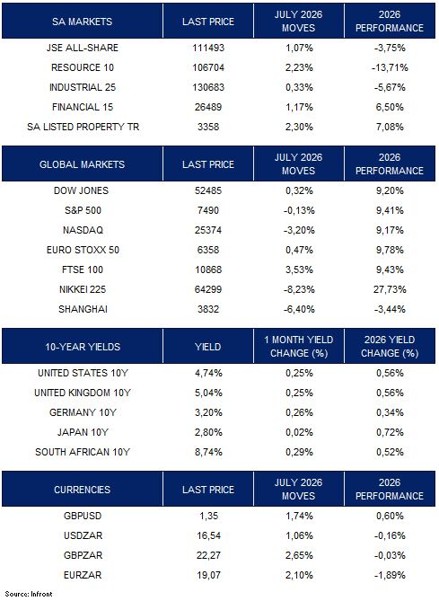
South African equities recovered, leaving the FTSE/JSE All-Share up 1.07% in July but down 3.75% for 2026. Resources gained 2.23%, Industrials 0.33%, Financials 1.17% and listed property 2.30%. Naspers, Prosus and miners helped reverse two months of weakness, although new U.S. tariffs complicated the outlook for exporters.
Global equities diverged sharply. The Dow Jones gained 0.32%, while the S&P 500 fell 0.13% and the Nasdaq fell 3.20% as technology shares weakened. The FTSE 100 rose 3.53% and the Euro Stoxx 50 added 0.47%. In Asia, the Nikkei 225 fell 8.23% and the Shanghai Composite declined 6.40%.
Government-bond yields rose across all five markets, led by increases of 25 basis points in the United States and United Kingdom and 29 basis points in South Africa. The rand weakened across the major currencies, with USD/ZAR ending at 16.54, although it remained marginally stronger against the dollar for 2026.
Trends This Month
- Washington introduced targeted Section 301 duties as its temporary global tariff expired, while repayments of earlier tariffs increased the budget deficit.
- AI infrastructure moved from a technology theme to a national electricity and capital-allocation issue.
- Japan combined coordinated intervention to support the yen with a hawkish Bank of Japan hold, while semiconductor weakness weighed on equities.
- A more reliable electricity supply and infrastructure reforms may support South Africa’s domestic outlook, while the 12.5% U.S. tariff increases earnings risk for non-exempt exporters.
Artificial Intelligence – Power and Cash Flow Move Centre Stage
The scale of U.S. AI investment became a national policy issue in July. Under the White House Ratepayer Protection Pledge, large data-centre operators undertook to fund the generation and grid infrastructure required by their projects instead of shifting those costs to ordinary electricity users.
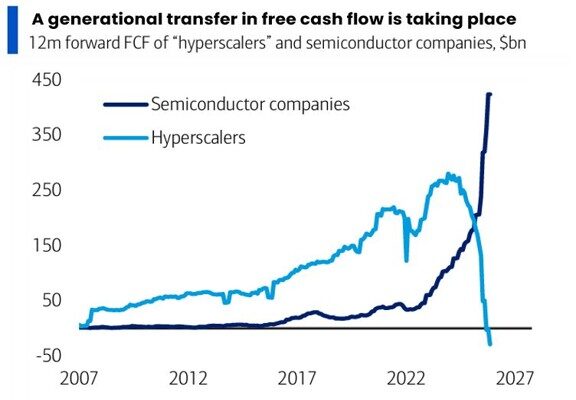
That commitment highlights a broader capital-allocation question. Hyperscalers are spending heavily on chips, data centres and power before the returns are fully visible, while semiconductor suppliers are capturing more of the immediate revenue. July’s technology sell-off showed that investors are increasingly distinguishing between beneficiaries within the same AI theme.
Takeaway: AI demand remains structural, but power availability, financing costs and the distribution of cash flow now matter as much as revenue growth.
United States – Strong Earnings Meet Tariff and AI Pressure
Equity Performance
- Dow Jones: +0.32%
- S&P 500: -0.13%
- Nasdaq: -3.20%
Second-quarter earnings were strong, with 85% of reporting S&P 500 companies exceeding expectations at the time of writing. Technology shares nevertheless weakened as investors questioned whether rising AI infrastructure spending would produce adequate returns.
Trade policy remained uncertain. On 24 July, the temporary global tariff expired and Washington replaced it with targeted duties of 10% or 12.5% on imports from 60 trading partners. Separately, the Supreme Court’s rejection of earlier emergency tariffs led to about $81 billion in refunds. These repayments helped widen the June budget deficit to $120 billion, making tariffs a budget issue as well as a trade issue.
The Federal Reserve held rates at 3.50%-3.75%, although three policymakers preferred an increase. Core inflation eased and second-quarter growth slowed, but concerns about persistent price pressures remained. The U.S. 10-year yield ended July at 4.74%, up 25 basis points.
Outlook: Strong earnings support U.S. equities, but tariffs, higher bond yields and uncertainty over returns from AI spending leave less room for error.
Europe – Resilient Markets Face Persistent Inflation
Equity Performance
- Euro Stoxx 50: +0.47%
- FTSE 100: +3.53%
European markets remained resilient in July. The FTSE 100 gained 3.53%, supported by its lower technology exposure and larger energy and financial sectors. Industrial and financial strength also helped the Euro Stoxx 50 add 0.47%, despite weakness in technology.
The economic backdrop was more mixed. Eurozone GDP grew 0.4% in the second quarter, but inflation rose to 2.9%. In the UK, the Bank of England kept rates at 3.75%, with three members favouring an increase. Meanwhile, Andy Burnham became prime minister on 20 July, promising cost-of-living relief and more power for regional governments while keeping existing budget rules.
Outlook: A broader mix of industries helped European markets hold up, but persistent inflation, high interest rates and uneven growth remain obstacles.
Japan – Technology Weakness Masks Broader Resilience
Equity Performance
- Nikkei 225: -8.23%
Japan’s Nikkei 225 fell 8.23% as semiconductor companies weakened, while the broader TOPIX ended largely unchanged. Its greater exposure to industrial, financial and domestically focused companies helped offset the decline in technology shares.
At month-end, Japan’s finance ministry bought yen to support the currency after it approached four-decade lows. Later reports confirmed unusual U.S. participation. The Bank of Japan kept its interest rate at 1.00% but warned that inflation risks could require further increases.
SoftBank was also reported to have reopened talks for a further $10 billion loan backed by its OpenAI stake. A separate $40 billion bridge facility matures in March 2027, highlighting the scale of financing behind its AI investments.
Outlook: Industrial and financial companies provide some balance, but semiconductor weakness, yen volatility and possible further rate increases remain risks.
China – Strong Exports Mask Weak Domestic Demand
Equity Performance
- Shanghai Composite: -6.40%
China’s official manufacturing PMI unexpectedly fell to 49.2 in July from 50.3, its first contraction in five months. New orders dropped to 48.5, their weakest level in more than three years, reinforcing concern that property weakness and soft domestic demand were outweighing pockets of industrial strength.
External demand remained powerful. Data released in July showed June exports rising 27% year on year and the trade surplus reaching $125.6 billion, helped by AI hardware and electronics. Beijing nevertheless called for stronger counter-cyclical support, domestic-demand measures and action to stabilise employment, businesses and expectations.
Outlook: Strong exports are supporting growth, but the July PMI and calls for further policy support show that weak domestic demand remains a major risk.
South Africa – Reform Progress Meets New Trade Pressure
Equity Performance
- JSE All-Share: +1.07%
- Resource 10: +2.23%
- Industrial 25: +0.33%
- Financial 15: +1.17%
- SA Listed Property TR: +2.30%
South African equities advanced in July, with the JSE All Share gaining 1.07%. Resources (+2.23%) and listed property (+2.30%) led, while recoveries in Naspers, Prosus and platinum miners helped reverse two months of market weakness.
The SARB unexpectedly held the repo rate at 7.00% despite headline inflation of 5.0% and core inflation of 4.1%. The rand weakened against the dollar, while the 10-year government bond yield rose 29 basis points to 8.74%.
Trade risk increased after a 12.5% U.S. tariff took effect on non-exempt South African goods. Domestic reforms provided some offset: Treasury secured a $1.5 billion World Bank budget-support loan tied to electricity, freight, water and sanitation reforms, completing its 2026/27 foreign-borrowing requirement.
By mid-July, Eskom reported financial-year-to-date energy availability of 65.46%, while Cabinet proposed petroleum reserves equal to 60 days of net imports, rising to 90 over time.
Outlook: Better electricity supply and reform progress support the outlook, but U.S. tariffs and high borrowing costs continue to hold back the recovery.
Currencies – Rand Weakens Against Major Currencies
Key Moves
- GBP/USD: +1.74% (1.35)
- USD/ZAR: +1.06% (16.54)
- GBP/ZAR: +2.65% (22.27)
- EUR/ZAR: +2.10% (19.07)
Currency markets reflected broad rand depreciation in July. USD/ZAR rose 1.06% to 16.54, while GBP/ZAR and EUR/ZAR increased by 2.65% and 2.10% respectively. The dollar also depreciated against sterling, with GBP/USD rising 1.74% to 1.35. Despite July’s weakness, the rand remained marginally stronger against the dollar and euro in 2026.
Takeaway: The rand remains sensitive to global risk appetite, local rate expectations and U.S. trade policy toward South Africa, even as its 2026 performance stays broadly resilient.
Fixed Income – Government Bond Yields Rise in July
10-Year Yields (End-July | MoM change)
- United States: 4.74% | +0.25%
- United Kingdom: 5.04% | +0.25%
- Germany: 3.20% | +0.26%
- Japan: 2.80% | +0.02%
- South Africa: 8.74% | +0.29%
Government bond yields rose in July, which generally meant weaker bond prices. South Africa recorded the largest increase, followed by Germany, the United States and the United Kingdom. Japan’s yield was broadly unchanged.
Persistent inflation concerns and cautious central banks raised the possibility that interest rates could remain high for longer. South Africa’s 10-year yield rose to 8.74% as investors weighed global inflation risks and uncertainty over the domestic interest-rate outlook.
Takeaway: Bond markets remain sensitive to inflation and changes in central-bank policy.
Final Thoughts – Uneven Markets Reward Careful Choices
July was not a month of broad market weakness. Instead, performance differed sharply between sectors and countries. Strong company earnings and continued AI investment supported parts of the market, while higher bond yields, new tariffs and uncertainty over returns from technology spending created pressure elsewhere.
In South Africa, better electricity supply and reform progress were encouraging, but U.S. tariffs and high borrowing costs remained obstacles. The companies and sectors investors choose therefore matter more than the direction of the market as a whole.
What this means for portfolios
- Maintain the long-term portfolio mix: Strong earnings support equities, while tariffs, higher yields and uneven performance make large short-term changes difficult to justify.
- Review technology and AI concentration: July showed that even strong long-term themes can create risk when portfolios become too concentrated.
- Keep bond maturities balanced: This limits losses if yields rise further while allowing reinvestment at higher rates.
- Stay selective on South Africa: South Africa’s reform progress is positive, but U.S. tariffs and high borrowing costs could weigh on local companies and economic growth.
Market Moves of The Month
Source: Infront (07 August 2026)
Chart of The Month
Source: BofA Research Investment Committee (07 August 2026)
This BofA chart shows a sharp shift in expected cash generation within technology. Heavy AI infrastructure spending is reducing near-term free cash flow for the largest cloud companies, while semiconductor firms benefit from strong demand for chips and equipment. Cloud platforms are funding much of the AI buildout, while hardware suppliers capture more of the immediate financial benefit.