In This Edition:
US POLICY HOLDS AS INFLATION EASES AND GROWTH SLOWS
The Federal Reserve maintained rates as softer core inflation offered some relief, but slower second-quarter growth and elevated headline inflation kept the policy outlook finely balanced.
EUROPEAN GROWTH REMAINS RESILIENT AS INFLATION RISKS PERSIST
Eurozone growth exceeded expectations and regional equities advanced, yet firmer services inflation and the Bank of England’s cautious hold underscored continuing price and energy risks.
ASIA FACES UNEVEN GROWTH AND SHIFTING TECHNOLOGY SENTIMENT
The Bank of Japan held rates as inflation approached the target, while China’s manufacturing contraction and volatile semiconductor sentiment highlighted uneven regional momentum.
GLOBAL MARKETS ADVANCE UNEVENLY AMID AI AND OIL VOLATILITY
US and European equities gained as technology sentiment improved, while mixed performance in Asia and sharp oil price moves reflected ongoing geopolitical and valuation uncertainty.
SOFTER PRODUCER INFLATION SUPPORTS SOUTH AFRICAN MARKETS
Lower producer inflation and a June budget surplus strengthened the domestic backdrop, with the JSE advancing and the rand appreciating against the US dollar.
MARKET MOVES OF THE WEEK
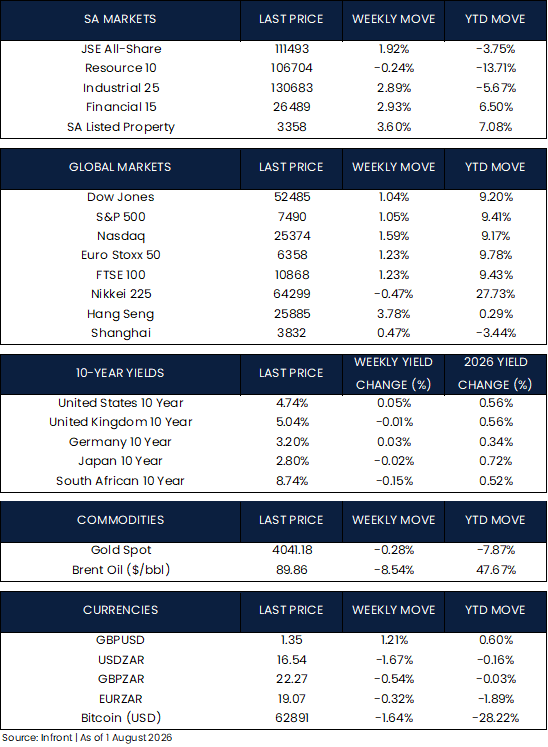
CHART OF THE WEEK
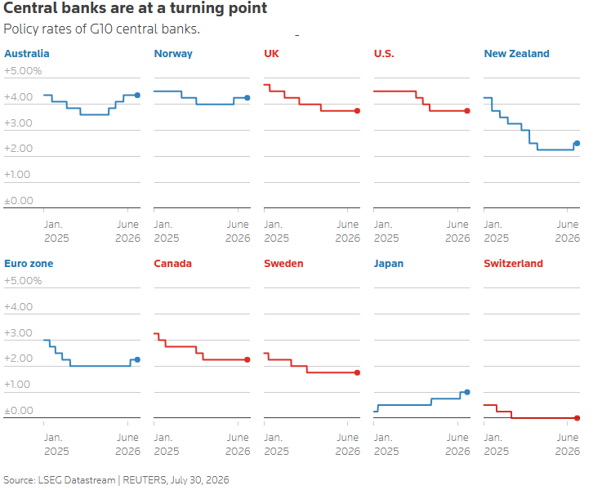
A renewed escalation in Middle East tensions and continued AI-driven investment reinforced a cautious stance among major central banks, with policymakers opting to keep interest rates unchanged.
US Policy Holds as Inflation Eases and Growth Slows
The Federal Reserve left its benchmark interest rate unchanged at 3.50%–3.75% for a fifth consecutive meeting, a decision widely expected by markets. While nine members of the Federal Open Market Committee voted to keep rates unchanged, three favoured a further increase, highlighting continued concerns over inflation.
The Federal Reserve’s preferred inflation measure provided some relief, with the Bureau of Economic Analysis (BEA) reporting that the core Personal Consumption Expenditures (PCE) price index, which excludes food and energy, rose 0.1% in June, down from 0.3% in May. Annual core inflation eased to 3.3% from 3.4%, while headline PCE inflation remained elevated at 3.7% despite a 0.1% monthly decline. The BEA also reported that the US economy expanded at an annualised rate of 1.5% in the second quarter, below consensus expectations and down from 2.1% in the first quarter, reflecting weaker government spending and slower investment and export growth.
European Growth Remains Resilient as Inflation Risks Persist
Eurozone GDP expanded 0.4% in the second quarter, exceeding market expectations. Growth was supported by AI-related investment and government spending, which helped offset the drag from the U.S.-Iran conflict and higher energy prices. Spain recorded the strongest growth among the region’s largest economies, with GDP expanding 0.7%. Annual inflation increased to 2.9% in July from 2.8% in June, in line with expectations, while services inflation rose to 3.3% and non-energy industrial goods inflation increased to 0.9% from 0.7%.
The Bank of England left Bank Rate unchanged at 3.75%. The Monetary Policy Committee voted 6–3 in favour of maintaining the policy rate, with three members preferring a 25 basis point increase. Policymakers cited persistent inflationary pressures and heightened uncertainty, warning that a renewed escalation of the conflict in the Middle East could prolong energy price volatility and increase upside risks to inflation.
Asia Faces Uneven Growth and Shifting Technology Sentiment
The Bank of Japan (BoJ) left its policy rate unchanged at 1.00%, following June’s increase to its highest level since 1995. One policy board member favoured a 25 basis point increase to 1.25%. The BoJ indicated that underlying inflation is approaching its 2% target and reiterated that future policy adjustments will depend on developments in economic activity, inflation and financial conditions.
China’s manufacturing Purchasing Managers’ Index (PMI) unexpectedly fell to 49.2 in July from 50.3 in June, below market expectations and marking its first contraction since February. The decline reflected weaker domestic demand, weather-related production disruptions and slower export activity, while new orders fell to 48.5, their lowest level in more than three years.
Investor demand for China’s semiconductor sector remained strong, with memory-chip manufacturer ChangXin Memory Technologies (CXMT) surging 466% on its market debut following Asia’s largest IPO of 2026. However, the broader semiconductor sector weakened later in the week as concerns over elevated valuations and AI-related capital expenditure weighed on sentiment.
Global Markets Advance Unevenly Amid AI and Oil Volatility
Global equity markets were mixed over the last week, with investors navigating the Federal Reserve’s policy decision, ongoing geopolitical tensions in the Middle East and continued volatility in AI-related stocks. In the US, major indices closed higher, with the Nasdaq Composite (+1.59%), S&P 500 (+1.05%) and Dow Jones Industrial Average (+1.04%) advancing.
European equities also ended the last week higher, with the pan-European STOXX Europe 50 Index rising 1.23% in local currency terms. Gains were supported by better-than-expected corporate earnings and a recovery in sentiment towards AI-related stocks later in the week, while Brent crude oil remaining below USD 100 per barrel provided an additional tailwind. The UK’s FTSE 100 Index also advanced 1.23%.
Asian equity markets delivered mixed performance over the last week. Japan’s Nikkei 225 Index declined 0.47%. In China, the Shanghai Composite Index gained 0.47%. Mainland technology shares came under pressure as semiconductor and other AI-related stocks weakened, although sentiment improved later in the week following stronger-than-expected US technology earnings. Meanwhile, Hong Kong’s Hang Seng Index advanced 3.78%, supported by gains in large internet companies, including Tencent and Alibaba.
Brent crude oil declined 8.54% over the last week to USD 89.86 per barrel. Despite the weekly decline, Brent remained more than 22% higher for July, marking its strongest monthly gain since March, as escalating tensions in the Middle East fuelled concerns over global oil supplies.
Softer Producer Inflation Supports South African Markets
Statistics South Africa reported that producer inflation slowed to 7.5% year-on-year in June from 7.8% in May, below market expectations of 7.9%. The softer-than-expected reading was largely driven by lower fuel and food prices, indicating some moderation in upstream price pressures despite elevated consumer inflation. Separately, National Treasury recorded a budget surplus of R80.13 billion in June, indicating that government revenue exceeded expenditure during the month.
South African equities advanced over the last week, with the JSE All Share Index rising 1.92%. Gains were led by the industrial (+2.89%), financial (+2.93%) and listed property (+3.60%) sectors, while resource shares (-0.24%) underperformed amid softer commodity prices. The rand also strengthened against the US dollar, appreciating 1.67% to close the week at R16.54/USD.
The information contained in this recording/presentation is for general information purposes only and should not be construed as, nor does it constitute, financial, tax, legal, investment or any other advice. Carrick does not guarantee the suitability or potential value of any products or investments discussed herein. We make no representations or warranties of any kind, express or implied, about the completeness, accuracy, reliability, suitability or availability with respect to the information, products, services, or any other content contained in this recording for any purpose. Carrick accepts no responsibility for the suitability or accuracy of the information or for any errors or omissions that may occur. Therefore, any reliance you place on such information is strictly at your own risk. This material is provided for general information purposes only and is not personal advice to anyone to invest in any fund or product. Information taken from trade and other sources is believed to be reliable, although Carrick does not represent this as accurate or complete and it shouldn’t be relied upon as such. All material, content, and information provided by Carrick is the intellectual property of Carrick Group and its affiliates, unless otherwise stated. No part of this material may be copied, reproduced, distributed, published, or used for any commercial purpose without Carrick’s prior written consent, and is provided solely for non-commercial use. Capital is at risk. The value and income from investments can go down as well as up and are not guaranteed. An investor may get back significantly less than they invest. Past performance is not a reliable indicator of current or future performance and should not be the sole factor considered when selecting an investment.