
In this Edition:
AI DEBT TESTS THE TECHNOLOGY TRADE
Investors questioned the scale and cost of borrowing behind the AI build-out, driving technology shares lower and increasing scrutiny of credit risk.
OIL SHOCK KEEPS INFLATION AND FED RISK ELEVATED
Brent crude climbed above $109 as Middle East and Russia–Ukraine supply risks intensified, while higher US consumer and producer prices kept another Fed hike in consideration.
EUROPE GAINS DESPITE PERSISTENT INFLATION PRESSURE
European equities advanced even as higher energy costs lifted inflation and industrial production weakened across the eurozone.
ASIA BEARS THE BRUNT OF AI REPRICING
Japan and South Korea suffered sharp equity losses, while strong Chinese exports contrasted with subdued domestic inflation and demand.
SOUTH AFRICA LOOKS TO THE BUDGET AS LOCAL ASSETS STRENGTHEN
Improved mining tax receipts raised hopes for a better fiscal position, while the JSE, rand and government bonds all ended the week firmer.
MARKET MOVES OF THE WEEK
Source: Infront (17 October 2026)
CHART OF THE WEEK
Source: S&P Global Market Intelligence/LSEG - Reuters (15 October 2026)
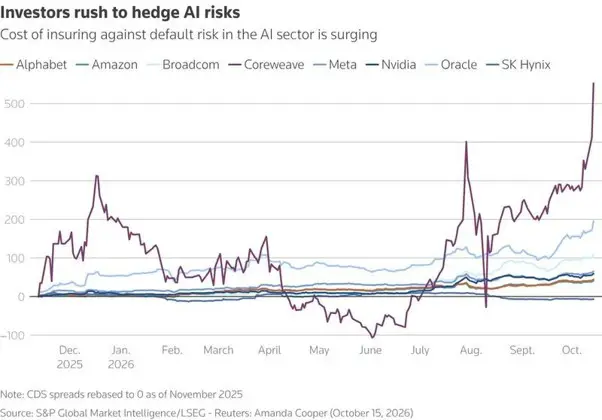
Investors are paying more to insure against defaults on debt issued by AI-related companies. CoreWeave’s credit default swaps rose above 1,000 basis points this week, a record level implying a roughly 63% probability of default over five years, while Oracle’s also climbed sharply. Even Alphabet, Amazon, Meta and Nvidia saw insurance costs reach record highs, although their increases were far smaller.
South African investors enter an important fiscal week with local assets on a firmer footing but global inflation risks again moving higher. The JSE gained, the rand strengthened, and government bond yields declined, while stronger mining tax receipts have raised expectations for the Medium-Term Budget Policy Statement. At the same time, Brent crude above $109 adds pressure to an economy already dealing with elevated fuel costs. The SARB’s October Monetary Policy Review notes that the policy rate has risen to 7.25% and projects headline inflation above 5% until the second quarter of 2027, reinforcing the importance of energy prices for both domestic interest rates and household spending.
AI Debt Tests the Technology Trade
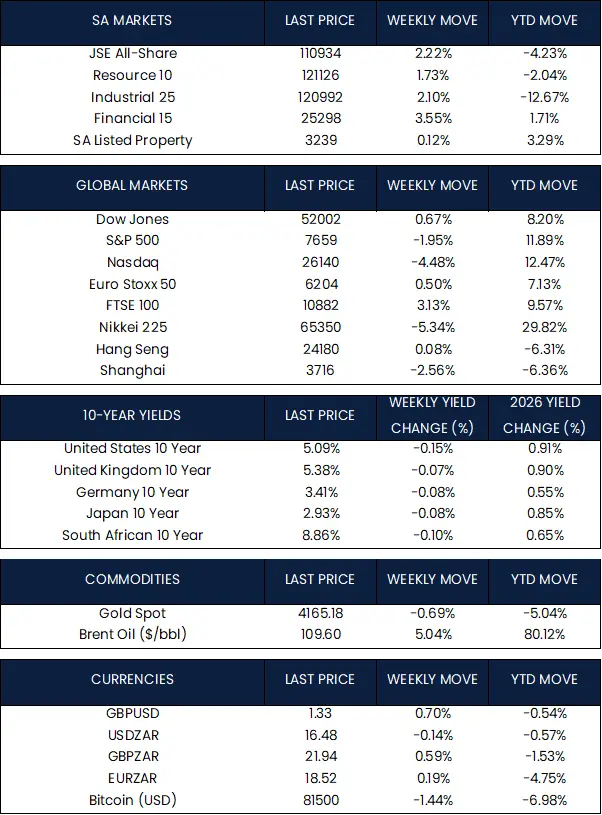
The AI trade ran into a harder question last week: not whether the technology will deliver, but who is financing the build-out and at what price. Investors turned their attention to the scale of borrowing behind the expansion, and the scrutiny quickly spilt into credit markets, where the cost of insuring debt issued by several AI-linked companies rose sharply. The Nasdaq fell 4.48%, and the S&P 500 gave up 1.95%, while the more value-oriented Dow managed a 0.67% gain. The rotation out of technology found a home in government bonds, pulling the US ten-year yield down 15 basis points to 5.09%.
The IMF raised its global growth forecast for 2026 to 3.1%, from 3.0% in July, supported by AI investment and resilient trade, while leaving its 2027 forecast unchanged at 3.4%. However, the outlook remains cautious. Although the global economy has so far weathered the energy shock, a prolonged supply disruption and a potential reassessment of AI expectations remain key downside risks.
Oil Shock Keeps Inflation and Fed Risk Elevated
On the energy front, supply fears intensified after an attack on Saudi Aramco’s headquarters and threats of further strikes on Saudi oil facilities. Hopes of relief from the Russia–Ukraine conflict also faded as the energy ceasefire brokered by Trump collapsed, with Ukraine resuming strikes on Russian energy infrastructure in response to continued Russian attacks on its own facilities. Brent crude closed the last week 5.04% higher at $109.60 a barrel, despite US efforts to bring additional Russian diesel onto global markets.
Higher energy costs remained central to the US inflation picture. Consumer prices rose 0.6% in September, lifting annual inflation to 3.7%. Core prices rose a more modest 0.3% over the month and 2.6% over the year. The bigger warning came from producer prices, which jumped 1.3% as increases spread beyond energy into other goods and services. That pipeline pressure keeps the prospect of a further Federal Reserve hike firmly on the table.
Economic data presented a mixed picture, with headline figures masking underlying weakness. Retail sales increased by 0.8%, although underlying sales grew by just 0.1%. Industrial production was more encouraging, rising 0.7%, while manufacturing output increased by 0.3%.
Earnings season opened with a mixed showing from the major US banks. Loan growth held up and consumers kept spending, but softer investment-banking and fixed-income trading activity weighed on parts of the sector. JPMorgan reported its first earnings miss since late 2023 and Bank of America also disappointed, while Goldman Sachs and Citigroup beat expectations.
Europe Gains Despite Persistent Inflation Pressure
European markets finished higher, with the Euro Stoxx 50 gaining 0.50% and the FTSE 100 advancing 3.13%. The economic backdrop was less encouraging, with higher energy prices lifting inflation and industrial activity weakening.
Final figures put eurozone inflation at 3.8% in September, up from 3.2% in August, while core inflation edged up to 2.5%. Industrial production fell 0.5% in August, its third consecutive monthly decline.
In the UK, the economy grew 0.1% in August, confounding expectations of a modest contraction. Manufacturing, led by pharmaceuticals, did the heavy lifting while services were flat. Bank of England chief economist Huw Pill pushed back against market pricing of four rate increases over the coming year, though he cautioned that inflation could prove stubborn.
Asia Bears the Brunt of AI Repricing
In Japan, wholesale prices rose 6.8% from a year earlier in September, slowing from 7.6% in August. Even so, Bank of Japan Governor Kazuo Ueda said the central bank would keep raising interest rates, warning that underlying inflation could overshoot its 2% target. Core machinery orders, a leading indicator of business investment, rebounded 5.2% in August after falling 3.7% in July. That did little to shield equities, with the Nikkei 225 falling 5.34%.
The retreat from the AI trade hit Asian technology names hardest. South Korea’s Kospi suffered its worst week since October 2008, falling 14.46%, with an 8% slide on Thursday triggering a 20-minute trading halt.
China’s data told a two-sided story. September exports surged 36.3% year on year in dollar terms and imports rose 31.0%, pushing the monthly trade surplus to a record $133.5 billion. Higher energy and commodity costs drove producer price inflation up to 5.0% from 3.8% in August, yet consumer inflation crept up to only 0.9%, held back by weak domestic demand. The Shanghai Composite lost 2.56%, while Hong Kong’s Hang Seng was broadly flat, edging up 0.08%.
South Africa Looks to the Budget as Local Assets Strengthen
In South Africa, attention turned to this week’s Medium-Term Budget Policy Statement, as stronger mining tax receipts raised expectations of improved government finances. Bank of America estimates that 2026/27 revenue could exceed February’s budget projections by R70 billion, driven largely by gold and precious-metals producers. The bank nevertheless expects much of the extra revenue to be spent, so the deficit would narrow only slightly, to 3.5% of GDP against the Treasury’s 3.7% target. Morgan Stanley anticipates three months of renewed fuel-tax relief in the budget, which it estimates would reduce its inflation forecast by half a percentage point.
Mining activity remained under pressure, with output falling 12.7% year-on-year in August. The decline was led by a sharp 22.5% contraction in platinum-group metals, while coal and iron ore production also recorded significant declines.
Local markets ended last week on a positive note, with the JSE All-Share rising 2.22%, led by a 3.55% gain in financial shares. The rand strengthened 0.14% to R16.48 against the US dollar, while the 10-year government bond yield declined by 10 basis points to 8.86%, reflecting improved sentiment across local asset classes.
The information contained in this recording/presentation is for general information purposes only and should not be construed as, nor does it constitute financial, tax, legal, investment or any other advice. Carrick does not guarantee the suitability or potential value of any products or investments discussed herein. We make no representations or warranties of any kind, express or implied, about the completeness, accuracy, reliability, suitability or availability with respect to the information, products, services, or any other content contained in this recording for any purpose. Carrick accepts no responsibility for the suitability or accuracy of the information or for any errors or omissions that may occur. Therefore, any reliance you place on such information is strictly at your own risk. This material is provided for general information purposes only and is not personal advice to anyone to invest in any fund or product. Information taken from trade and other sources is believed to be reliable, although Carrick does not represent this as accurate or complete and it shouldn’t be relied upon as such. All material, content, and information provided by Carrick is the intellectual property of Carrick Group and its affiliates, unless otherwise stated. No part of this material may be copied, reproduced, distributed, published, or used for any commercial purpose without Carrick’s prior written consent, and is provided solely for non-commercial use. Capital is at risk. The value and income from investments can go down as well as up and are not guaranteed. An investor may get back significantly less than they invest. Past performance is not a reliable indicator of current or future performance and should not be the sole factor considered when selecting an investment.