

In this Edition:
MARKET MOVES OF THE WEEK
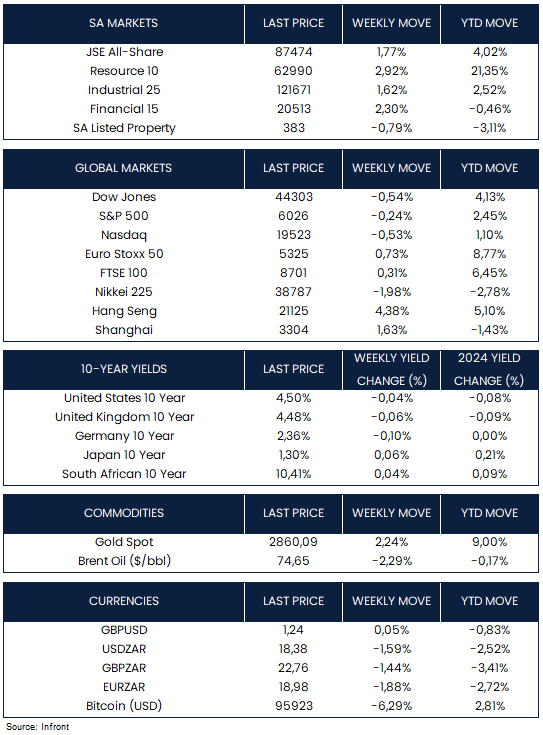
CHART OF THE WEEK
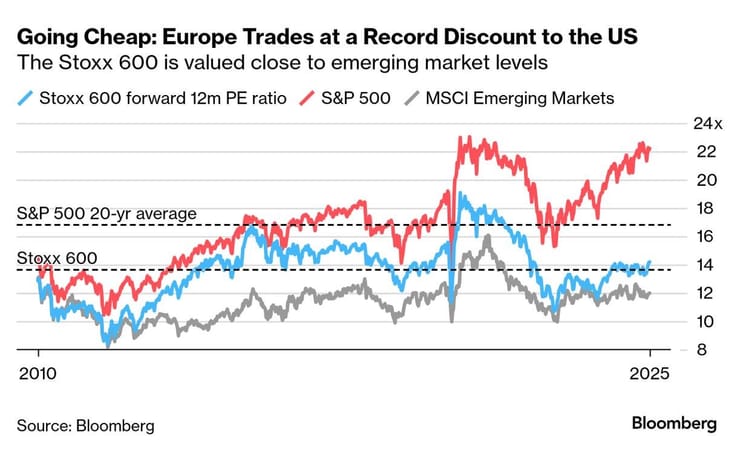
There is growing concern in Europe that its markets are broken, risking the loss of future businesses. U.S. stocks on average trade at 22 times earnings, a near 60% premium over Europe. Companies like UK chip designer Arm Holdings and Swedish fintech Klarna have chosen the US for their primary stock market listings, and New York has also caught the eye of France’s TotalEnergies and Britain’s WPP. Source: Bloomberg
Major U.S. indexes fell last week, with the S&P 500 faring best, dropping just 0.24%. Stocks dropped sharply at the start of last week following President Trump’s Friday announcement of 25% tariffs on Mexico and Canada and 10% on Chinese imports. However, by Monday’s close, Trump delayed the Mexico and Canada tariffs for 30 days, offering some relief and helping stocks recover part of their early losses.
Markets largely shrugged off the China tariffs, as Trump had previously threatened tariffs as high as 60% during his campaign. China responded with 15% tariffs on under $40 billion in U.S. imports, effective February 10, while also initiating antitrust probes into U.S. tech firms and tightening export controls on key minerals. Although no tariffs have been imposed on the European Union yet, Trump warned on Sunday that they “definitely will”.
U.S. earnings reports also played a key role in shaping sentiment as investors processed a busy week of releases. According to FactSet, 77% of S&P 500 companies that reported fourth-quarter results through Friday exceeded earnings expectations, with an average growth rate of 16.4% (compared to the 11.9% forecast). Additionally, 63% of these companies beat sales projections.
U.S. Treasury Secretary Scott Bessent said the Trump administration is focused on the 10-year Treasury yield, not the federal funds rate, and isn’t pressuring the Fed to cut rates. The administration aims to reduce energy prices, lower government size, and boost growth.
On the economic data side, the U.S. manufacturing sector expanded in January for the first time since October 2022, but services slowed. The key economic event of last week was Friday’s nonfarm payrolls report. The U.S. economy added 143,000 jobs in January, below expectations and down from December’s revised 307,000. The unemployment rate unexpectedly dropped to 4.0% from 4.1%.
The Bank of England cut its base rate by 0.25% to 4.5% in a 7-2 vote, with two members advocating for a larger cut. Governor Andrew Bailey expects further rate reductions. Inflation is expected to rise temporarily to 3.7%, while the 2025 growth forecast was halved to 0.75%. UK equities reacted positively, with the FTSE 100 reaching a record high, ending last week up 0.31%. Meanwhile, the Euro Stoxx 50 led developed markets, rising 0.73% w/w.
Mainland Chinese stock markets rose in a shortened trading week, as strong consumer spending during the Lunar New Year holiday helped offset President Trump’s decision to impose a 10% tariff on Chinese imports. The Shanghai Index climbed 1.63% from Wednesday to Friday, while in Hong Kong, the Hang Seng Index gained 4.38%, marking its best weekly performance in four months, fuelled by strong gains in tech stocks.
South African manufacturers indicated a decline in business conditions for the third consecutive month in January, according to a local purchasing managers’ index (PMI) survey released on Monday. The seasonally adjusted PMI, backed by South African bank Absa, dropped to 45.3 points in January from 46.2 in December, moving further below the 50-point threshold that separates expansion from contraction.
President Cyril Ramaphosa delivered the first State of the Nation Address under the Government of National Unity on Thursday. Below, we’ve summarized the key points:
Medium Term Development Plan: The five-year plan, released on Friday, focuses on inclusive growth, job creation, poverty reduction, and building a capable, ethical state. Emphasis is placed on a competent public service.
Municipalities: Urgent focus on water and electricity, with Operation Vulindlela 2 addressing water issues. Revenue from water and electricity will be reinvested into maintenance and investment to tackle the growing municipal debt.
Network Industries: A “second wave of reform” will target SOEs and infrastructure, with a focus on maintaining state ownership of strategic assets while leveraging private investment and skills.
Electricity: Plans to implement the building blocks for a competitive electricity market in F25/26, including private investment in the transmission network.
Freight & Logistics: Reforms will continue, with the Freight Logistics Roadmap being implemented and private capital involved.
Visa Reforms: The Department of Home Affairs has cleared 90% of a 300,000 visa backlog, with digital public infrastructure and a new Electronic Travel Authorisation system streamlining visa applications.
The All-Share Index rose by 1.77% this week, driven by gains in Resources (+2.92%) and Financials (+2.30%). The local currency strengthened against the U.S. dollar, moving to R18.38/$ from last week’s R18.67/$ level. SA government bonds remained relatively stable, as yields on the 10-year rose 0.04% over last week.
The information contained in this recording/presentation is for general information purposes only and should not be construed as, nor does it constitute financial, tax, legal, investment or any other advice. Carrick does not guarantee the suitability or potential value of any products or investments discussed herein. We make no representations or warranties of any kind, express or implied, about the completeness, accuracy, reliability, suitability or availability with respect to the information, products, services, or any other content contained in this recording for any purpose. Carrick accepts no responsibility for the suitability or accuracy of the information or for any errors or omissions that may occur. Therefore, any reliance you place on such information is strictly at your own risk. This material is provided for general information purposes only and is not personal advice to anyone to invest in any fund or product. Information taken from trade and other sources is believed to be reliable, although Carrick does not represent this as accurate or complete and it shouldn’t be relied upon as such. All material, content, and information provided by Carrick is the intellectual property of Carrick Group and its affiliates, unless otherwise stated. No part of this material may be copied, reproduced, distributed, published, or used for any commercial purpose without Carrick’s prior written consent, and is provided solely for non-commercial use. Capital is at risk. The value and income from investments can go down as well as up and are not guaranteed. An investor may get back significantly less than they invest. Past performance is not a reliable indicator of current or future performance and should not be the sole factor considered when selecting an investment.