
In this Edition:
MARKET MOVES OF THE WEEK
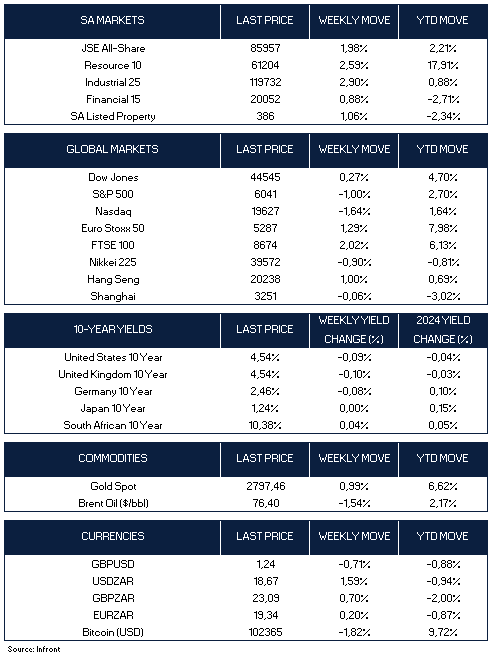
CHART OF THE WEEK
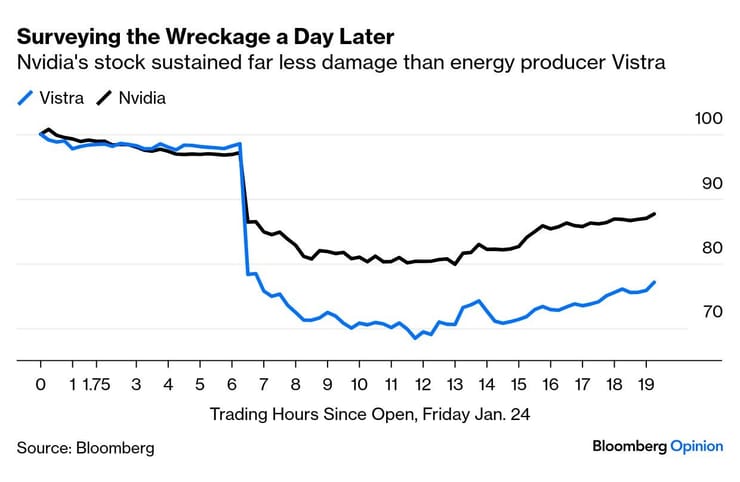
The launch of DeepSeek, China’s generative AI competitor, triggered a sharp U.S. market sell-off on Monday. While markets have since rebounded, losses remain. Nvidia regained some ground after losing $580 billion in value, but the broader impact appears more severe for utility companies expected to supply the additional power needed for AI data centres. AI’s vast computational power demands lead to high electricity consumption, particularly in data centres. The worst performer in this sector was Vistra Corp. Source: Bloomberg
The Nasdaq Composite Index saw a sharp decline at the start of last week, largely driven by concerns over intensifying competition in the AI sector. DeepSeek, a Chinese AI developer, unveiled a new energy-efficient language model, raising investor concerns about Nvidia’s dominance. This led to a nearly 17% drop in Nvidia shares before a partial recovery, aided by strong earnings reports from Meta and Apple. Meanwhile, the U.S. government increased scrutiny on China’s AI sector, accusing DeepSeek of using illegally sourced Nvidia chips, further escalating trade tensions.
Trade policy uncertainty intensified after former U.S. President Donald Trump reaffirmed his stance on tariffs, pledging to reintroduce a 25% tariff on Mexican and Canadian goods by 1 February, alongside a 10% levy on Chinese imports. This disappointed investors who had hoped for a more moderate approach.
The Federal Reserve maintained interest rates at 4.25% to 4.50% as widely expected. Fed Chair Jerome Powell emphasised strong economic activity, a resilient labour market, and persistent inflation. He reiterated that the Fed would need more substantial evidence of inflation easing or labour market weakness before considering rate cuts. Investors remain watchful of how potential Trump-era economic policies, particularly tariffs, might influence the Fed’s future decisions.
Core PCE inflation stood at 2.8% year-on-year in December, remaining above the Fed’s 2% target. The U.S. economy grew at an annualised 2.3% in Q4, slightly below expectations but above the Fed’s long-term forecast of 1.8%. Consumer spending surged 4.2%, offsetting inventory declines. However, consumer confidence hit a four-month low in January due to job and wage concerns.
The Bank of Canada cut interest rates by 25 basis points but removed forward guidance, citing tariff uncertainties. The European Central Bank (ECB) held rates steady, maintaining its deposit rate at 2.75% as eurozone growth stagnated. ECB President Christine Lagarde noted that inflation was under control but expressed caution about further rate cuts. Meanwhile, Brazil’s central bank raised its key Selic rate by 100 basis points to 13.25% to curb inflation and stabilise the currency.
The eurozone economy stagnated in Q4, with Germany and France contracting, while overall growth for 2024 stood at just 0.7%. Inflation trends were mixed: Germany reported 2.8%, France slowed to 1.8%, and Spain rose to 2.9%. Trade policy concerns, particularly U.S. tariffs, continue to weigh on the region’s economic outlook.
The Bank of Japan (BoJ) maintained a hawkish stance following its recent rate hike. Deputy Governor Ryozo Himino indicated that further tightening would depend on inflation trends, with Tokyo’s core consumer prices rising 2.5% in January.
China’s economy began 2025 on a weak note, with manufacturing PMI falling to 49.1, signalling contraction. Non-manufacturing activity also weakened, slipping to 50.2. Large industrial firms saw a 3.3% profit decline in 2024, marking a third consecutive year of losses. Deflationary pressures and a prolonged real estate downturn continue to weigh on demand, while trade tensions with the U.S. add further uncertainty.
Global markets delivered mixed results last week. In the U.S., the Dow Jones edged up 0.27%, while the S&P 500 and Nasdaq declined by 1.00% and 1.64%, respectively. European markets performed better, with the Euro Stoxx 50 gaining 1.29% and the FTSE 100 rising 2.02%. In Asia, Japan’s Nikkei 225 slipped 0.90%, while Hong Kong’s Hang Seng added 1.00%, and the Shanghai Composite dipped slightly by 0.06%. Brent crude oil fell 1.54% to $76.40 per barrel, while gold surged to a record high, closing last week at $2,797.46 per ounce.
South Africa’s Monetary Policy Committee (MPC) reduced interest rates by 25 basis points this week, citing a favourable near-term inflation outlook. However, they highlighted concerns over medium-term risks due to “global developments,” particularly the potential inflationary impact of Trump-era tariffs. The South African Reserve Bank (SARB) warned that in a trade war scenario, the rand could weaken to R21.00 per US dollar, with domestic inflation rising to 5.0%. In its base-case forecast, SARB expects inflation to average 3.9% in 2025, 4.6% in 2026, and 4.5% in 2027. Meanwhile, GDP growth projections were revised slightly upward to 1.8% for 2025 (from 1.7%), with forecasts of 1.8% in 2026 and 2.0% in 2027.
Following ten months of stable electricity supply, Eskom reinstated Stage 3 load shedding due to multiple breakdowns requiring extended repairs. CEO Dan Marokane described this as a temporary setback, citing ongoing structural improvements in the generation fleet. Depleted emergency reserves, will need to be replenished over the weekend.
On the JSE, the All Share Index rose by 1.98% over the week, with all three major sectors posting gains—resources up 2.59%, industrials rising 2.90%, and financials advancing 0.88%. By Friday’s close, the rand weakened to R18.67 against the US dollar.
The information contained in this recording/presentation is for general information purposes only and should not be construed as, nor does it constitute financial, tax, legal, investment or any other advice. Carrick does not guarantee the suitability or potential value of any products or investments discussed herein. We make no representations or warranties of any kind, express or implied, about the completeness, accuracy, reliability, suitability or availability with respect to the information, products, services, or any other content contained in this recording for any purpose. Carrick accepts no responsibility for the suitability or accuracy of the information or for any errors or omissions that may occur. Therefore, any reliance you place on such information is strictly at your own risk. This material is provided for general information purposes only and is not personal advice to anyone to invest in any fund or product. Information taken from trade and other sources is believed to be reliable, although Carrick does not represent this as accurate or complete and it shouldn’t be relied upon as such. All material, content, and information provided by Carrick is the intellectual property of Carrick Group and its affiliates, unless otherwise stated. No part of this material may be copied, reproduced, distributed, published, or used for any commercial purpose without Carrick’s prior written consent, and is provided solely for non-commercial use. Capital is at risk. The value and income from investments can go down as well as up and are not guaranteed. An investor may get back significantly less than they invest. Past performance is not a reliable indicator of current or future performance and should not be the sole factor considered when selecting an investment.