
In this Edition:
MARKET MOVES OF THE WEEK
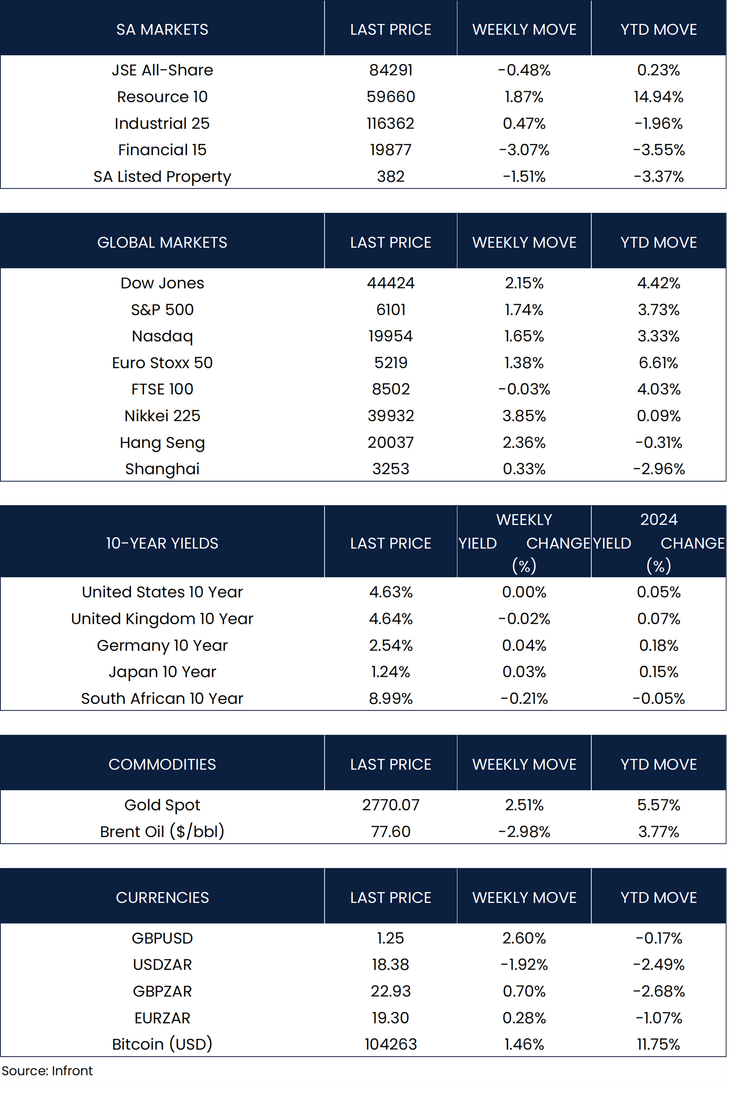
CHART OF THE WEEK
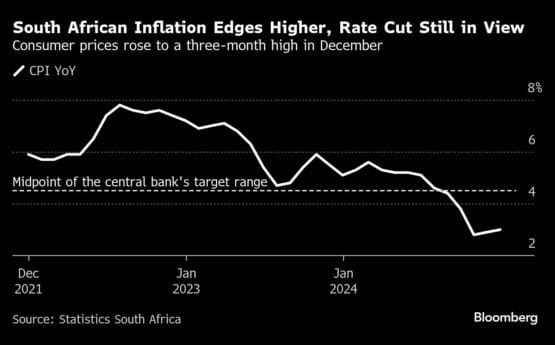
South Africa’s consumer prices rose by 3% in December, up from 2.9% the previous month, according to Statistics South Africa. This was lower than the 3.2% forecast by economists. The modest inflation increase, coupled with a strengthening rand, supports expectations that the South African Reserve Bank could proceed with a 25 basis point cut to the repo rate, bringing it to 7.5%
Following President Donald Trump’s inauguration on Monday, political developments were a key focus last week. Trump ordered a review of U.S. trade policies, with plans to implement 25% tariffs on Canada and Mexico by February. His comments about preferring to avoid tariffs on China encouraged cautious optimism about a potential trade agreement, contributing to positive market sentiment.
President Trump also announced a USD 500 billion joint venture with Softbank, OpenAI, Oracle, and MGX to support AI infrastructure development in the U.S., which lifted AI-related stocks on expectations of increased investment in the sector.
In economic news, U.S. business activity expanded in January, though at the slowest pace in nine months due to rising price pressures. The S&P Global Composite PMI fell to 52.4 from 55.4 in December, its lowest since April but still indicating expansion. The U.S. manufacturing sector returned to growth after six months of contraction, with the PMI improving to 50.1 from 49.4, surpassing forecasts of 49.6. Services activity grew at a reduced pace, with the PMI easing to 52.8 from 56.8.
In the UK, wage growth excluding bonuses reached a six-month high of 6.0% in the three months to November, aligning with expectations. However, the unemployment rate unexpectedly rose to 4.4%, alongside the largest decline in payroll numbers since November 2020 and a continued drop in job openings.
In the eurozone, business activity showed slight improvement in January, with the S&P Global Composite Output Index rising to 50.2 from 49.6, indicating marginal expansion. Services activity grew modestly for the second consecutive month, while manufacturing remained in contraction. Despite current challenges, manufacturers expressed optimism about future output growth.
The Bank of Japan (BoJ) raised its policy rate for the third time, increasing it by 0.25 percentage points to approximately 0.5%, the highest level since the 2008 global financial crisis. This rate hike was widely anticipated by markets, driven by a 3.6% year-on-year rise in consumer prices, including food and energy.
Major indexes posted gains in the holiday-shortened week, with U.S. markets closed on Monday in observance of Martin Luther King, Jr. Day. The Dow Jones advanced 2.15%, the S&P 500 rose 1.74%, and the Nasdaq Composite increased 1.65%. In Europe, the Euro Stoxx 50 Index advanced 1.38%, while the UK’s FTSE 100 posted a marginal decline of 0.03%.
Chinese equities rose, buoyed by expectations that President Trump may take a less aggressive approach on tariffs, with the Shanghai Composite up 0.33% and the Hang Seng Index in Hong Kong climbing 2.36%. Japanese markets also saw positive performance, with the Nikkei 225 rising 3.85%.
Statistics South Africa (Stats SA) reported that Consumer Price Inflation (CPI) ticked higher to 3% in December, compared to 2.9% in November, marking the second consecutive month of inflationary pressure. On a month-on-month basis, CPI increased by 0.1% in December, reflecting a modest uptick in price levels. Furthermore, Stats SA revealed that the average annual CPI for 2024 was 4.4%, a notable decline of 1.6 percentage points from the 6% average inflation rate recorded in 2023.
Retail sales in South Africa rose by 7.7% in November, following a revised 6.2% increase in October, according to Stats SA. This marked the ninth consecutive month of growth, driven by Black Friday promotions and the “two pot” pension withdrawal scheme. The growth exceeded market expectations of 5.5%, representing the strongest increase in retail activity since July 2022 and the highest since June 2010. The uptick in sales was broad-based, with six of seven retail sectors experiencing growth.
At the World Economic Forum (WEF) in Davos, President Cyril Ramaphosa discussed South Africa’s economic recovery, focusing on attracting foreign investment, driving infrastructure growth, and addressing energy challenges. He acknowledged fiscal pressures, emphasising the need for consolidation, debt reduction, and reform, while highlighting the importance of balancing fiscal discipline with social spending to foster job creation. Ramaphosa reaffirmed South Africa’s commitment to ongoing economic reforms and global engagement.
Unlike its global counterparts, the JSE All-Share Index declined by 0.48%, primarily driven by a 3.07% drop in the financial sector. The property sector also underperformed, falling by 1.51%. In contrast, the resources sector maintained its positive momentum, rising by 1.87%, while the industrial sector posted modest gains of 0.47%. By Friday’s close, the rand appreciated by 1.92% against the U.S. dollar, trading at R18.38.
The information contained in this recording/presentation is for general information purposes only and should not be construed as, nor does it constitute financial, tax, legal, investment or any other advice. Carrick does not guarantee the suitability or potential value of any products or investments discussed herein. We make no representations or warranties of any kind, express or implied, about the completeness, accuracy, reliability, suitability or availability with respect to the information, products, services, or any other content contained in this recording for any purpose. Carrick accepts no responsibility for the suitability or accuracy of the information or for any errors or omissions that may occur. Therefore, any reliance you place on such information is strictly at your own risk. This material is provided for general information purposes only and is not personal advice to anyone to invest in any fund or product. Information taken from trade and other sources is believed to be reliable, although Carrick does not represent this as accurate or complete and it shouldn’t be relied upon as such. All material, content, and information provided by Carrick is the intellectual property of Carrick Group and its affiliates, unless otherwise stated. No part of this material may be copied, reproduced, distributed, published, or used for any commercial purpose without Carrick’s prior written consent, and is provided solely for non-commercial use. Capital is at risk. The value and income from investments can go down as well as up and are not guaranteed. An investor may get back significantly less than they invest. Past performance is not a reliable indicator of current or future performance and should not be the sole factor considered when selecting an investment.