
In this Edition:
MARKET MOVES OF THE WEEK
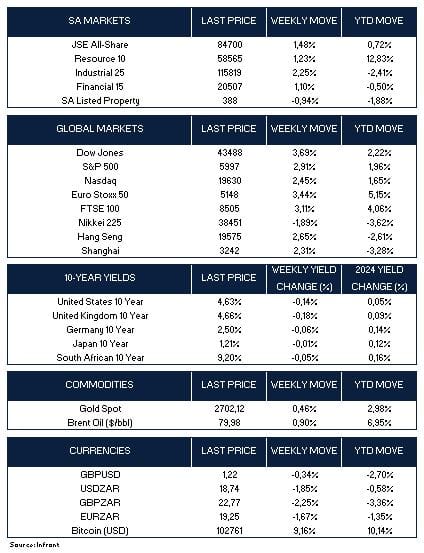
CHART OF THE WEEK
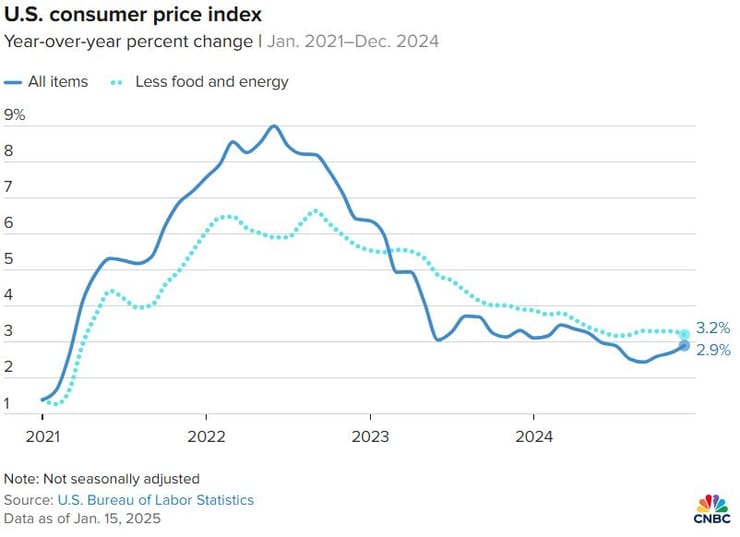
The consumer price index increased a seasonally adjusted 0.4% on the month, putting the 12-month inflation rate at 2.9%, the Bureau of Labor Statistics reported Wednesday. Economists surveyed by Dow Jones had been looking for respective readings of 0.3% and 2.9%. However, excluding food and energy, the core CPI annual rate was 3.2%, a notch down from the month before and slightly better than the 3.3% forecast.
Last week’s economic indicators and market performance signal cautious optimism, with inflation cooling in key regions and corporate earnings boosting confidence.
In the U.S. the consumer price index (CPI) increased by a seasonally adjusted 0.4% in December, bringing the 12-month inflation rate to 2.9%, according to the U.S. Bureau of Labor Statistics. While the headline figure indicated a slight acceleration from November, core inflation, which excludes food and energy, rose by only 0.2% in December—its smallest increase since July. Year-over-year core inflation also eased to 3.2% from 3.3% in November, falling slightly below expectations. Following the report, U.S. Treasury yields strengthened across most maturities, reflecting investor optimism.
The inflation report arrives amid heightened market sensitivity to Federal Reserve policy signals as well as concerns over tariffs and potential inflationary pressures linked to policies from President-elect Donald Trump.
The positive inflation print as well as strong earnings reports from major banks buoyed investor sentiment last week with both the Dow Jones Industrial Average and the S&P 500 climbing 3.7% and 2.9%, respectively, marking their strongest weekly gains since the U.S. presidential election in November. The Nasdaq also posted a solid 2.5% gain.
Negotiators reached a deal on Wednesday for a ceasefire in the Gaza war between Israel and Hamas. Israel’s security cabinet approved the deal on Friday. Under the terms of the first phase of a three-phase agreement, Hamas is to release 33 hostages and Israel is to free Palestinian prisoners while the two sides attempt to negotiate a lasting truce in six weeks.
In Europe, slower-than-expected inflation in both the Eurozone and the U.S. raised hopes for further central bank rate cuts. The pan-European STOXX Europe 50 Index gained 3.44% for last week, while the U.K.’s FTSE 100 Index rose 3.11% after annual consumer price growth in the U.K. unexpectedly slowed to 2.5% in December, bolstering expectations for a Bank of England rate cut as early as February.
In Asia, Japanese equities faced headwinds as the Nikkei 225 Index fell 1.9% amid hawkish signals from Bank of Japan officials, heightening expectations of a potential rate hike at the upcoming policy meeting. Conversely, Chinese markets rallied with the Shanghai Composite Index gaining 2.31%, while the benchmark Hang Seng Index was up 2.73%, according to FactSet. The gains were supported by stronger-than-expected economic data. China’s GDP grew 5.4% in Q4, lifting full-year 2024 growth to 5.0% in line with official targets. Retail sales rose 3.7% year-over-year in December, while industrial output expanded 6.2%. However, consumer inflation remained subdued, and the urban unemployment rate ticked up slightly to 5.1%.
Crude oil prices rose amid new U.S. sanctions on Russian oil companies, reducing supply to China and India and pushing those countries to buy more on the open market. Brent crude ended last week up 0.9% at $79.98 per barrel. Gold prices saw marginal gains, closing at $2,702 per ounce, as lower U.S. Treasury yields increased demand for safe-haven assets.
In South Africa, the number of consumers applying for loans and those falling into arrears hit a record high in the third quarter, according to data released by the National Credit Regulator on Tuesday. The report revealed 18.1 million credit applications during the quarter, marking a 3% increase from the second quarter and a nearly 50% surge since the end of 2021, when the economy began recovering from the Covid-19 pandemic. Notably, mortgage arrears climbed to 6.9% of outstanding loans, and overdue payments (one to three months late) remained elevated, reflecting financial strain on consumers.
The JSE All Share Index advanced 1.48% for the week, driven by significant gains in industrial luxury goods retailer Cie Financiere Richemont S.A. Shares of the company soared 14.5% after reporting a 10.0% increase in third-quarter 2025 sales, supported by double-digit growth across the Americas, EMEA, and Japan.
On the currency front, the rand strengthened in cautious trading on Friday, closing the week at 18.74 against the U.S. dollar, representing a weekly gain of 1.85%. Market sentiment was influenced by investor attention shifting towards the U.S. President-elect Donald Trump’s upcoming inauguration on Monday.
The information contained in this recording/presentation is for general information purposes only and should not be construed as, nor does it constitute financial, tax, legal, investment or any other advice. Carrick does not guarantee the suitability or potential value of any products or investments discussed herein. We make no representations or warranties of any kind, express or implied, about the completeness, accuracy, reliability, suitability or availability with respect to the information, products, services, or any other content contained in this recording for any purpose. Carrick accepts no responsibility for the suitability or accuracy of the information or for any errors or omissions that may occur. Therefore, any reliance you place on such information is strictly at your own risk. This material is provided for general information purposes only and is not personal advice to anyone to invest in any fund or product. Information taken from trade and other sources is believed to be reliable, although Carrick does not represent this as accurate or complete and it shouldn’t be relied upon as such. All material, content, and information provided by Carrick is the intellectual property of Carrick Group and its affiliates, unless otherwise stated. No part of this material may be copied, reproduced, distributed, published, or used for any commercial purpose without Carrick’s prior written consent, and is provided solely for non-commercial use. Capital is at risk. The value and income from investments can go down as well as up and are not guaranteed. An investor may get back significantly less than they invest. Past performance is not a reliable indicator of current or future performance and should not be the sole factor considered when selecting an investment.