

In this Edition:
MARKET MOVES OF THE WEEK
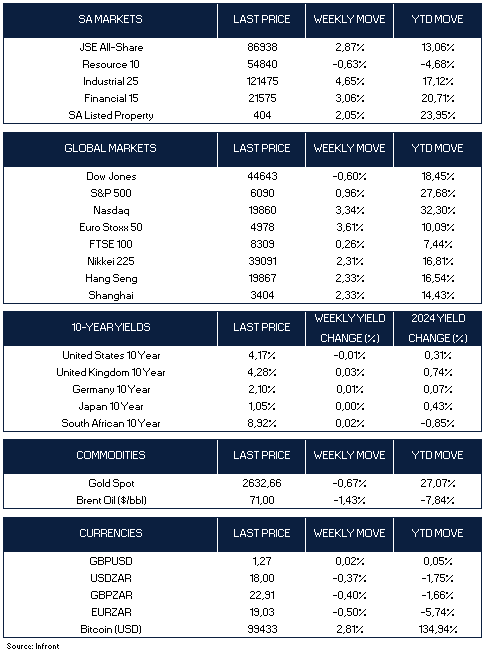
CHART OF THE WEEK
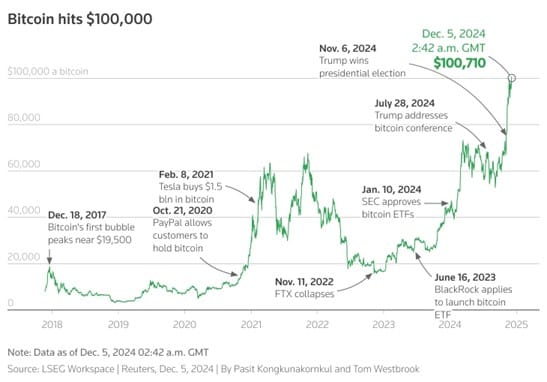
Bitcoin catapulted above $100,000 for the first time on Thursday, a milestone hailed even by sceptics as a coming-of-age for digital assets as investors bet on a friendly U.S. administration to cement the place of cryptocurrencies in financial markets. Source: Reuters
French Prime Minister Michel Barnier’s minority government collapsed after Parliament passed a no-confidence motion led by the National Rally and the left-wing New Popular Front, blocking the 2025 deficit-reduction budget. This political turmoil caused the yield spread between German 10-year bunds and French 10-year OATs—a key indicator of eurozone risk—to spike to 90 basis points, its highest level since 2012. The spread later narrowed below 80 basis points after President Emmanuel Macron announced plans to appoint a new prime minister soon and to work with political leaders across the spectrum to form a “government of general interest.”
Elsewhere on the political front, South Korea’s Kospi Index lost only 0.5% on the week after an attempt by President Yoon Suk Yeol to declare martial law quickly fizzled when the country’s parliament voted 190-0 to rescind the declaration. Yoon is likely to face impeachment proceedings and be removed from office, setting the stage for fresh elections.
In the U.S., nonfarm payrolls increased by 227,000 in November, rebounding sharply from October’s hurricane-affected slowdown. The unemployment rate ticked up to 4.2% from 4.1%, while average hourly earnings grew 4% year-over-year. Despite the strong payrolls data, markets focused on a significant drop in household employment, which increased expectations for a December rate cut to around 90%.
As trade tensions between the United States and China escalated, China announced a ban on the export of certain rare earth minerals to the U.S. These minerals are essential for the production of advanced semiconductor chips. This decision came shortly after the U.S. Department of Commerce imposed new restrictions on the sale of high-bandwidth memory chips produced by American and foreign companies to China. The ban includes critical materials such as gallium, germanium, and antimony, which have significant applications in both civilian technology and military sectors.
On the market front, major indexes were mostly higher last week. The S&P 500 (+0.96%), the Nasdaq Composite (+3.34%) and the Dow Jones (-0.60%) all hit fresh highs during last week. Sector performance varied, with consumer discretionary, communication services and information technology stocks rising over 3% for the week. In contrast, energy, utilities, and materials sectors—traditionally more value-focused—declined by more than 3%. Shares in Europe rose 3.61% (Euro Stoxx 50) while the FTSE 100 gained 0.26%.
Chinese stocks rose in response to expectations of new stimulus measures. The Shanghai Composite Index increased by 2.33%, while in Hong Kong, the Hang Seng Index saw a 2.33% rise. In Japan, the Nikkei 225 gained 2.31% over last week. Brent oil prices declined by 1.43%, while gold dropped by 0.67%.
South Africa’s Q3 2024 GDP fell by 0.3% q/q, missing Bloomberg’s forecast of 0.4% growth. The decline was mainly due to a 29% drop in agricultural output. Southern Africa has faced its worst drought in decades this year, hurting economic output across the region. GDP Growth for the year so far is just 0.4%, and achieving the 1.1% annual target would require a 2.9% rebound in Q4, which seems unlikely. Bloomberg has revised their 2024 growth forecast to 0.7%, with agriculture and retail spending, influenced by two-pot withdrawals, being key factors to watch.
South Africa’s manufacturing activity declined in November, with Absa’s PMI dropping to 48.1 from 52.6 in October, signalling a contraction. Despite lower local inflation and interest rates, demand remains volatile. Global demand provided some support, but a weaker rand and domestic uncertainties pose ongoing risks. Absa also noted global political and trade concerns following Donald Trump’s U.S. presidential election victory.
The All-Share Index rose by 2.87% last week, driven largely by gains in Industrials (+4.65%) and Financials (+3.06%). The local currency marginally strengthened against the U.S. dollar, strengthening to R18.00/$ from the previous week’s R18.07/$ level. SA government bonds remained relatively stable, as yields on the 10-year rose 0.02% over the week.
The information contained in this recording/presentation is for general information purposes only and should not be construed as, nor does it constitute financial, tax, legal, investment or any other advice. Carrick does not guarantee the suitability or potential value of any products or investments discussed herein. We make no representations or warranties of any kind, express or implied, about the completeness, accuracy, reliability, suitability or availability with respect to the information, products, services, or any other content contained in this recording for any purpose. Carrick accepts no responsibility for the suitability or accuracy of the information or for any errors or omissions that may occur. Therefore, any reliance you place on such information is strictly at your own risk. This material is provided for general information purposes only and is not personal advice to anyone to invest in any fund or product. Information taken from trade and other sources is believed to be reliable, although Carrick does not represent this as accurate or complete and it shouldn’t be relied upon as such. All material, content, and information provided by Carrick is the intellectual property of Carrick Group and its affiliates, unless otherwise stated. No part of this material may be copied, reproduced, distributed, published, or used for any commercial purpose without Carrick’s prior written consent, and is provided solely for non-commercial use. Capital is at risk. The value and income from investments can go down as well as up and are not guaranteed. An investor may get back significantly less than they invest. Past performance is not a reliable indicator of current or future performance and should not be the sole factor considered when selecting an investment.