

In this Edition:
MARKET MOVES OF THE WEEK
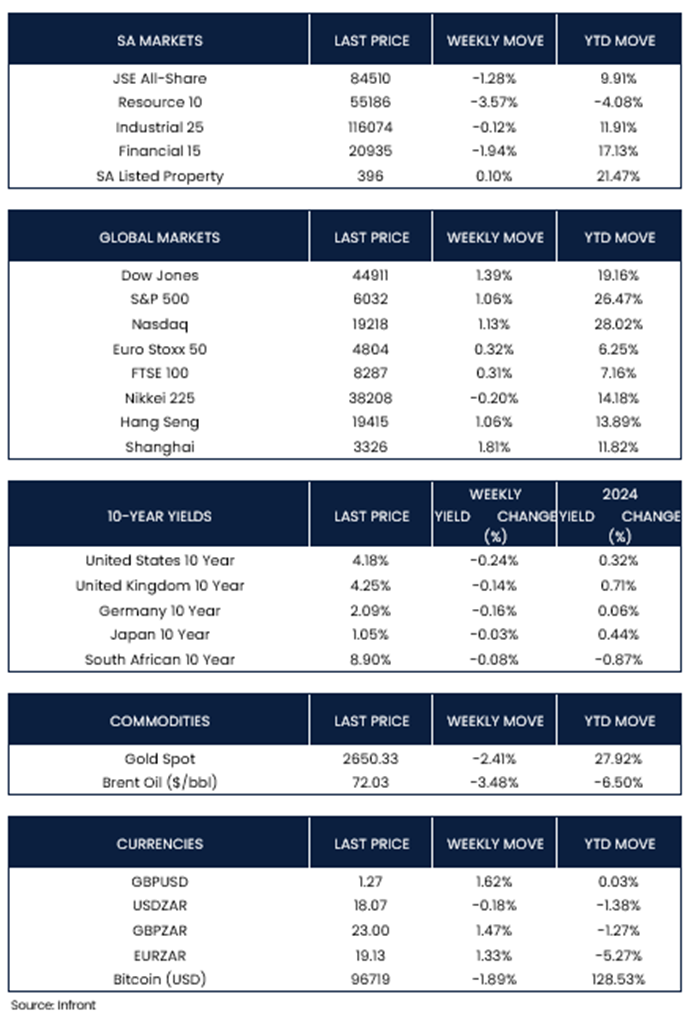
CHART OF THE WEEK
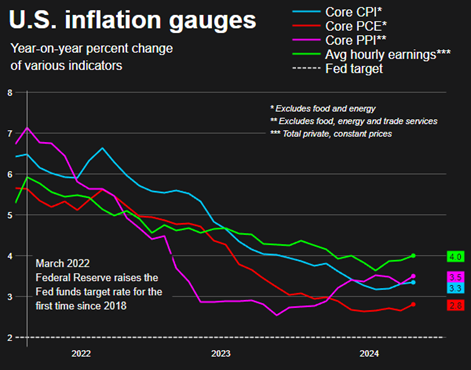
Inflation continues to cool, but at a slower pace. The personal consumption expenditures (PCE) price index rose 0.2% in October, matching September’s gain. Year-on-year, the PCE increased 2.3%, up from 2.1% in September, while the core PCE edged up 2.8%. Source: LSEG Datastream
The Federal Open Market Committee’s November 7 minutes showed broad support for moving toward a neutral monetary policy stance, though uncertainty remains about the neutral interest rate level. Policymakers noted core inflation remains elevated but are confident it is moving toward the 2% target, though some warned the process could take longer. The labour market showed stability, and downside risks to growth and employment have eased. Markets see a 67% chance of a 0.25% rate cut at the December 18 meeting.
The Fed’s preferred inflation measure, the PCE price index, rose 2.3% year-over-year in October, up from 2.1% in September, while core PCE edged higher to 2.8%. Both figures met expectations. Personal income surged 0.6% in October, doubling forecasts, while spending increased by 0.4%. Separately, the second Q3 GDP estimate was unchanged at 2.8%, though personal consumption was revised slightly downward to 3.5% annualized growth from 3.7%.
Trade tensions dominated investor sentiment as President-elect Trump issued tariff threats targeting Mexico, Canada, and China, prompting declines in the Mexican peso and Canadian dollar. However, markets found some reassurance in Trump’s nomination of Scott Bessent, a seasoned hedge fund manager, as Treasury Secretary, a move seen as signalling a pragmatic approach to fiscal and financial policy.
Eurozone annual inflation rose to 2.3% in November, up from 2.0% in October, based on a preliminary estimate. Services inflation eased slightly to 3.9% from 4.0%, while core inflation, which excludes food, energy, alcohol, and tobacco, remained stable at 2.7%.
The People’s Bank of China injected RMB 900 billion into the banking system via its medium-term lending facility, maintaining the lending rate at 2%. With RMB 1.45 trillion in loans set to mature next month, the operation resulted in a net withdrawal of RMB 550 billion for November. Increased local government bond issuance is expected to add liquidity pressures as Beijing intensifies efforts to stimulate the economy.
On the economic front, industrial firm profits fell 10% year-on-year in October, improving from the 27.1% drop in September. This slower decline was partly driven by government support and stronger profit growth in the equipment and high-tech manufacturing sectors.
US stocks posted gains for the week, largely unaffected by US President-elect Donald Trump’s tariff threats. Trading was closed on Thursday for Thanksgiving Day and ended early on Friday. The Dow Jones rose 1.39%, the Nasdaq Composite gained 1.13%, and the S&P 500 increased by 1.05%.
In Europe, the STOXX Europe 50 Index ended 0.32% higher, while the UK’s FTSE 100 rose 0.31%, despite uncertainty around US trade tariffs and interest rates.
In Asia, Chinese equities rose on hopes for government support, with the Shanghai Composite up 1.81% and Hong Kong’s Hang Seng Index gaining 1.05%. In contrast, Japan’s Nikkei 225 slipped 0.2% in the week.
Producer price inflation (PPI) in South Africa fell by 0.7% month-on-month in October, resulting in a year-on-year decline of -0.7%. This was significantly lower than market expectations, following a 1.0% increase in September. The sharp drop in producer inflation can largely be attributed to substantial fuel price cuts, with petrol and diesel prices falling by 22.2% and 26.9% year-on-year, respectively, in October.
The International Monetary Fund (IMF) has once again urged South Africa to pursue its economic reforms with greater urgency, stressing the need to prioritise reforms in the electricity and logistics sectors, which are key barriers to higher growth Following its Article IV consultation from 11 to 25 November, the IMF forecasted growth of 1.1% for 2024 and 1.5% for 2025. The 2024 forecast aligns with the National Treasury’s projection, while the 2025 forecast is slightly below the 1.7% outlined in the Medium-Term Budget Policy Statement.
In company news, grocery retailer Pick n Pay raised R8.5 billion by selling a 34.4% stake in its discount chain Boxer at R54 per share through an initial public offering. This marks the second and final phase of CEO Sean Summers’ recapitalisation plan to reduce the group’s debt and address challenges in its underperforming core Pick n Pay supermarkets business.
Unlike its global counterparts, the JSE All-Share Index declined by 1.28%, primarily driven by a 3.57% drop in the resources sector. The financial sector also underperformed, falling 1.94%, while the industrial sector saw a modest decline of 0.12%. The property sector was the only sector to post a gain, rising by 0.10%. By Friday’s close, the rand strengthened by 0.18% against the U.S. dollar, trading at R18.07.
The information contained in this recording/presentation is for general information purposes only and should not be construed as, nor does it constitute financial, tax, legal, investment or any other advice. Carrick does not guarantee the suitability or potential value of any products or investments discussed herein. We make no representations or warranties of any kind, express or implied, about the completeness, accuracy, reliability, suitability or availability with respect to the information, products, services, or any other content contained in this recording for any purpose. Carrick accepts no responsibility for the suitability or accuracy of the information or for any errors or omissions that may occur. Therefore, any reliance you place on such information is strictly at your own risk. This material is provided for general information purposes only and is not personal advice to anyone to invest in any fund or product. Information taken from trade and other sources is believed to be reliable, although Carrick does not represent this as accurate or complete and it shouldn’t be relied upon as such. All material, content, and information provided by Carrick is the intellectual property of Carrick Group and its affiliates, unless otherwise stated. No part of this material may be copied, reproduced, distributed, published, or used for any commercial purpose without Carrick’s prior written consent, and is provided solely for non-commercial use. Capital is at risk. The value and income from investments can go down as well as up and are not guaranteed. An investor may get back significantly less than they invest. Past performance is not a reliable indicator of current or future performance and should not be the sole factor considered when selecting an investment.