
In this Edition:
MARKET MOVES OF THE WEEK
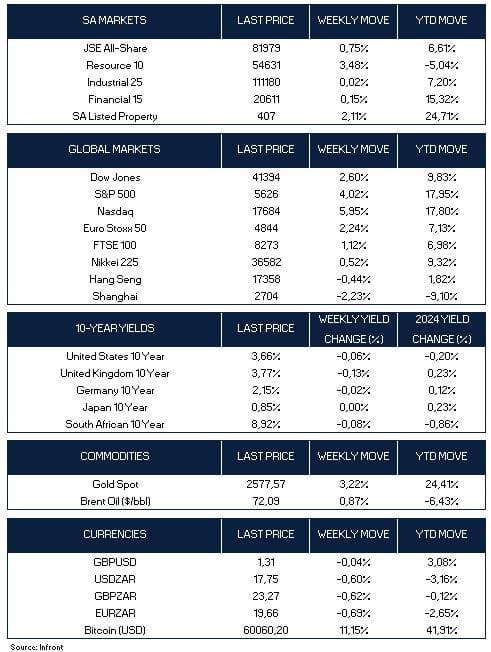
CHART OF THE WEEK
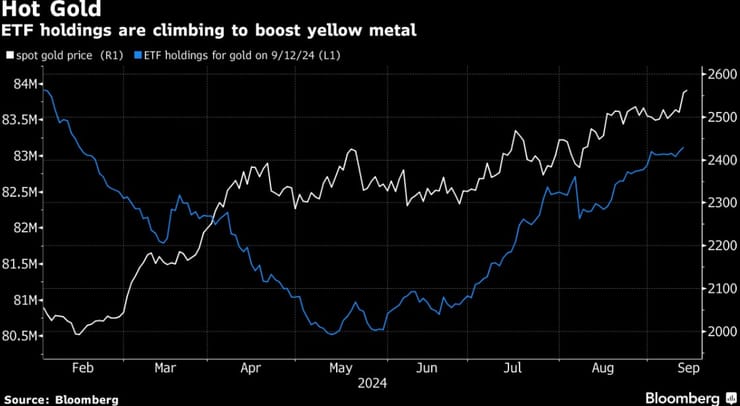
As per the chart above, bullion prices are likely to continue rising, bolstered by a fourth consecutive month of inflows into global Gold ETFs in August, as reported by the World Gold Council last week. This upward momentum is supported by anticipated interest rate cuts from the Federal Reserve next week, along with ongoing geopolitical tensions from conflicts in the Middle East and the Russia-Ukraine war, which further strengthen gold’s appeal as a safe-haven asset.
Gold surged to new record highs this week, driven by a weakened US dollar. Spot gold closed the week at $2,577 per ounce, marking a 3.2% increase. The rise in the gold price is attributed to an expected interest rate cut from the Federal Reserve’s meeting on September 17-18, along with easing inflationary pressures. Typically, zero-yielding assets like gold benefit from lower interest rates.
Wall Street is now looking ahead toward the Fed’s policy meeting next week, where the central bank is largely anticipated to lower interest rates by 25 basis points. Currently, the Fed’s target rate is sitting at 5.25% to 5.5%. The Fed decision on Wednesday, is followed by the Bank of England (BoE) and the Bank of Japan (BoJ) meetings on Thursday and Friday, respectively. Markets are currently pricing in a 72% chance of a 25-basis-point U.S. rate cut at next week’s meeting, and a 28% chance of a 50-bps cut, the CME FedWatch tool showed this week.
According to a report released by the Bureau of Labor Statistics on Thursday, headline US CPI inflation (Consumer Price Index) eased to +2.5% in August (YoY), testing levels not seen since February 2021. Inflationary pressures pulled back from July’s reading of +2.9%. On a MoM basis, headline CPI inflation rose +0.2% in August, matching both market expectations and prior data. Core inflation which excludes volatile food and energy components, rose +3.2% in August, as expected, and unchanged from July’s release. However, core CPI was slightly higher than expected between July and August, increasing +0.3% from +0.2% (+0.2% consensus).
On a weekly basis, the S&P 500 rose 4% and the tech-heavy Nasdaq Composite gained 5.9%, the best week this year for both indices. The Dow advanced 2.6% for the week. Growth stocks outpaced value shares for the week, helped by a strong performance from technology stocks. Treasury yields strengthened during the week with the yield on the benchmark 10-year Treasury note trading at year-to-date lows.
In Europe, the pan-European STOXX Europe 50 Index ended the week 2.24% higher, lifted by an interest rate cut from the European Central Bank (ECB). The UK’s FTSE 100 Index was also firmer, gaining 1.12% for the week.
The European Central Bank lowered interest rates on Thursday, trimming the key deposit rate by 25 basis points to 3.5%. This was the second rate cut in the current rate-lowering cycle. “We shall remain data-dependent,” ECB President Christine Lagarde told reporters in Frankfurt, adding that Thursday’s decision was unanimous. The ECB’s announcement follows a plunge in inflation to 2.2% in August and figures showing the rapid wage increases driving price gains are slowing. The ECB is being cautious and has signalled it will take a slow approach to further cuts with markets expecting a further rate cut in December.
In Asia, Japan’s stock markets registered mixed performances over the week, with the Nikkei 225 Index gaining 0.5%. Chinese stocks declined for the week, as weak inflation data weighed on investor sentiment. The Shanghai Composite Index ended the week 2.23% lower.
China’s top legislative body has approved a proposal to raise the country’s retirement age to tackle the economic pressure of a shrinking workforce. The retirement age will be raised for men to 63 years old from 60, while for women in white collar work it would be raised to 58 years from 55. For women in blue collar work it will be increased to 55 from 50. The changes are set to come into force on Jan. 1, 2025 and be implemented over a 15 year period.
The South African Reserve Bank is expected to cut its repo rate by 25 basis points to 8.00% at its Sept. 19 meeting as slowing inflation bolsters prospects of easing monetary policy. Eighteen of 21 economists surveyed in the past week said the SARB would cut by 25 basis points (bps) next week, while three expected rates to be held at 8.25%.
Inflation has slowed to an over three-year low in July to 4.6%, close to the central bank’s 3%-6% midpoint. Inflation is expected to average 4.7% this year and slow to 4.3% in 2025.
The international credit ratings agency Fitch Ratings has again kept SA’s credit rating unchanged, saying that while the formation of the government of national unity (GNU) has lowered short-term policy uncertainty, risks to political stability remain due to contentious issues such as the implementation of the national health insurance (NHI). Fitch’s rating remains at BB- with a stable outlook.
The JSE tracked global markets firmer for the week, gaining 0.75% as investors look ahead to next week’s Federal Reserve policy meeting. Resource counters and listed property led the gains. The rand firmed on Friday against a weaker dollar, trading at R17.75$ level at the close.
The information contained in this recording/presentation is for general information purposes only and should not be construed as, nor does it constitute financial, tax, legal, investment or any other advice. Carrick does not guarantee the suitability or potential value of any products or investments discussed herein. We make no representations or warranties of any kind, express or implied, about the completeness, accuracy, reliability, suitability or availability with respect to the information, products, services, or any other content contained in this recording for any purpose. Carrick accepts no responsibility for the suitability or accuracy of the information or for any errors or omissions that may occur. Therefore, any reliance you place on such information is strictly at your own risk. This material is provided for general information purposes only and is not personal advice to anyone to invest in any fund or product. Information taken from trade and other sources is believed to be reliable, although Carrick does not represent this as accurate or complete and it shouldn’t be relied upon as such. All material, content, and information provided by Carrick is the intellectual property of Carrick Group and its affiliates, unless otherwise stated. No part of this material may be copied, reproduced, distributed, published, or used for any commercial purpose without Carrick’s prior written consent, and is provided solely for non-commercial use. Capital is at risk. The value and income from investments can go down as well as up and are not guaranteed. An investor may get back significantly less than they invest. Past performance is not a reliable indicator of current or future performance and should not be the sole factor considered when selecting an investment.