
In this Edition:
MARKET MOVES OF THE WEEK
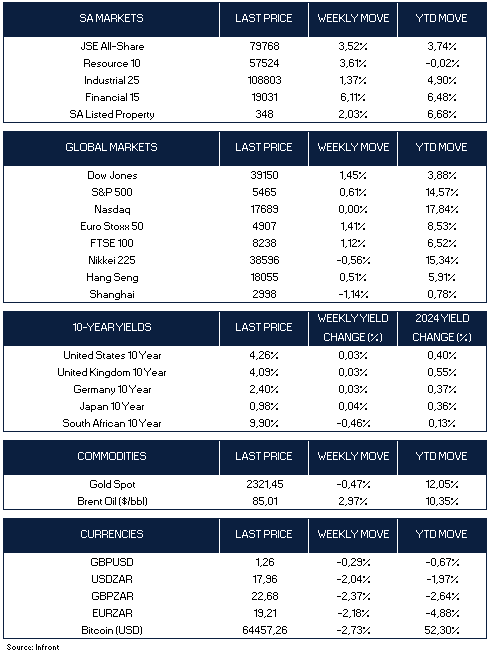
CHART OF THE WEEK
U.S. markets recorded modest gains last week despite a shortened trading session due to the Juneteenth holiday closure. The S&P 500 Index hit new all-time highs, driven by strong performances from value stocks over growth shares. Most major benchmarks outperformed the Nasdaq Composite, which is heavily weighted towards technology stocks.
Economic data from the U.S. presented a mixed outlook. Retail sales in May edged up by just 0.1%, following a revised 0.2% decline in April, indicating cautious consumer spending. In contrast, industrial production surged by 0.9% in May, its fastest growth in nearly a year, with factories operating at peak capacity since November. S&P Global’s composite index of business activity climbed to 54.6 in June, its strongest level in over two years, pointing to a robust economy despite subdued retail figures.
In the UK, the Bank of England kept its key interest rate steady at 5.25%, aligning with expectations. Headline inflation eased to 2% in May, but services inflation spiked to 5.7%, leading to scaled-back expectations for immediate rate cuts. Meanwhile, polls indicated a significant electoral challenge for Rishi Sunak’s Conservatives, with projections suggesting Labour could secure a historic 425 parliamentary seats.
In the eurozone, economic sentiment exceeded forecasts, reaching 51.30 in June from 47.00 in May. However, consumer price inflation slowed to a modest 0.2% increase in May from 0.6% in April. France and Italy faced EU criticism for their substantial deficits ahead of pivotal legislative elections, raising potential implications for both nations.
The Swiss National Bank lowered its policy rate to 1.25% in response to easing inflationary pressures. Conversely, the Bank of Japan discussed accelerating policy normalisation due to concerns over inflation linked to the weakened yen. In China, despite injections of RMB 182 billion into the banking system, new home prices fell by 0.7% in May, marking the sharpest monthly decline in almost ten years, underscoring persistent challenges in the property sector.
Global stocks generally performed well this week. In the U.S., the Dow Jones rose by +1.45% and the S&P 500 gained +0.61%, while the Nasdaq remained unchanged. European shares also showed strength, with the Euro Stoxx 50 up by +1.41% and the FTSE 100 by +1.12%. In contrast, Asian markets were mostly weaker; Japan’s Nikkei 225 declined by -0.56% and the Shanghai Composite fell by -1.14%, while the Hang Seng Index increased by +0.51%. Brent oil prices rose by +2.97%, whereas gold prices decreased by -0.47%.
In South Africa, investors continued to pay close attention to developments within the newly formed Government of National Unity (GNU), post the election outcome. The UDM became the latest party to join the ANC-led GNU, alongside the DA, IFP, Good, PA, and PAC. Negotiators from the GNU parties convened on Friday, 21 June, to finalise agreements on the Cabinet and other executive roles, with announcements expected by Sunday or early next week. While President Cyril Ramaphosa could take as long as needed to form the government, an ANC official emphasised the importance of avoiding a power vacuum and providing direction to capital markets.
South Africa’s consumer price index (CPI) remained steady at 5.2% in May on a year-on-year basis, aligning with market expectations. Retail sales in South Africa unexpectedly grew by 0.6% year-over-year in April, compared to a 2.3% increase in the prior month.
The South African market continued its upward trend following a positive election outcome, with the JSE rising by +3.52%. All three major sectors experienced solid gains: Resources increased by +3.61%, Industrials by +1.37%, and Financials by +6.11%. Additionally, the yield on the South African 10-Year Bond improved by 0.46%. The rand also strengthened significantly, closing at R17.96/$.
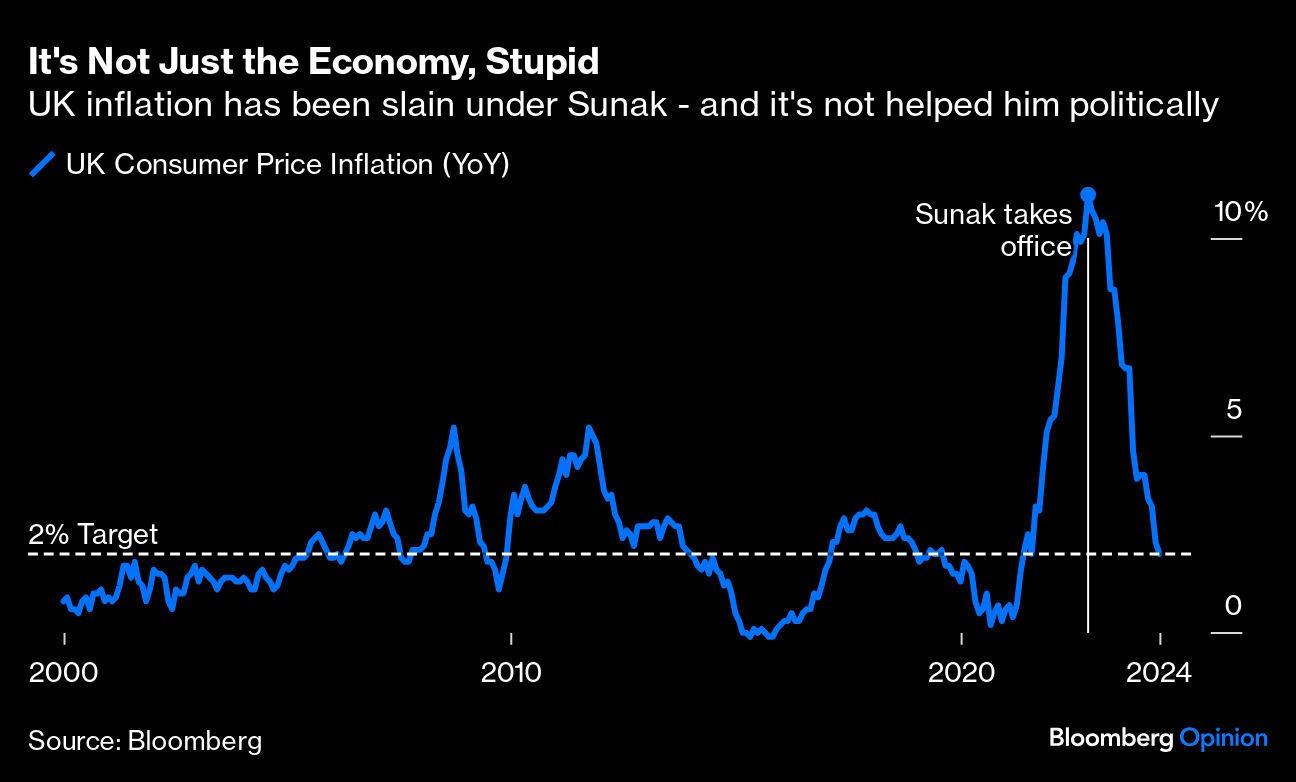
Inflation and politics intertwine with irony as Rishi Sunak assumed office in October 2022 with the daunting task of curbing inflation from over 10% to the long-term target of 2%. Surprisingly, recent data suggests this goal has been achieved. However, this economic success hasn’t bolstered Sunak’s electoral prospects. Recent UK polling indicates he may lose his parliamentary seat. Despite these developments, the Bank of England opted against rate cuts, citing concerns over inflation in the services sector, mirroring trends in the United States. Source: Bloomberg
The information contained in this recording/presentation is for general information purposes only and should not be construed as, nor does it constitute financial, tax, legal, investment or any other advice. Carrick does not guarantee the suitability or potential value of any products or investments discussed herein. We make no representations or warranties of any kind, express or implied, about the completeness, accuracy, reliability, suitability or availability with respect to the information, products, services, or any other content contained in this recording for any purpose. Carrick accepts no responsibility for the suitability or accuracy of the information or for any errors or omissions that may occur. Therefore, any reliance you place on such information is strictly at your own risk. This material is provided for general information purposes only and is not personal advice to anyone to invest in any fund or product. Information taken from trade and other sources is believed to be reliable, although Carrick does not represent this as accurate or complete and it shouldn’t be relied upon as such. All material, content, and information provided by Carrick is the intellectual property of Carrick Group and its affiliates, unless otherwise stated. No part of this material may be copied, reproduced, distributed, published, or used for any commercial purpose without Carrick’s prior written consent, and is provided solely for non-commercial use. Capital is at risk. The value and income from investments can go down as well as up and are not guaranteed. An investor may get back significantly less than they invest. Past performance is not a reliable indicator of current or future performance and should not be the sole factor considered when selecting an investment.